Real Stories, Real Results
Real Stories, Real Results
Real Stories, Real Results
Case Study #2: From Frustration to Clarity
How Wholistic Audiologic Care Transformed Louise’s Hearing Experience
For four years, Louise did everything right. She bought hearing aids: 2 sets in fact, first the Eargo 5, then the Eargo 7, both from a large online retailer. She wore them every day. She called customer support when they failed. She accepted the explanation that they were "programmed optimally." And still, she struggled.
Her frustrations came down to two things:
Poor performance. The number one reason anyone purchases hearing technology is to address personal hearing challenges. Unfortunately, neither of her OTC HA devices did this with any level of satisfaction. Her husband's voice across the dinner table, especially in any restaurant, was still unclear. During her monthly quilting group, where forty women have sewing machines running, she still couldn't participate in the group conversations. The places she loved most were the places she struggled most.
Poor reliability. Repeated device failures, charging issues, batteries that degraded so quickly she couldn't make it through a full day. Warranty support was responsive, and the customer service was, in her words, "very nice" but responsive isn't the same as resolved.
The devices did improve her hearing, somewhat. But neither set gave her confidence. Neither gave her reliability. And after four years of being told the aids were programmed optimally while knowing her experience told a different story, she decided enough was enough.
After a Duck Duck Go search for local hearing care, she found Visalia Hearing Center, and for the first time, decided to put her hearing in the hands of an American Board of Audiology Certified audiologist, and the difference was immediate.
A Different Approach to Hearing Care
From the initial visit, Louise noticed that Visalia Hearing Center’s process was unlike anything she had experienced before. She’d had a hearing test at a doctor’s office and an online test with Eargo before but nothing like this.
What she received was:
Extensive in-booth testing: while it seemed her previous testing tried to get her out of the booth as quickly as possible, she had 45-minutes of non-stop hearing measurements taken at Visalia Hearing Center. On a side note, while extra assessments might seem time-consuming, these detailed evaluations provide the insight needed for patients to succeed. If your Audiologist doesn’t fully understand what’s going on with your auditory system, how can they possibly find the best solution to remedy it?
Speech-in-noise testing that simulated real-world listening challenges: Louise described this assessment as “exactly what it’s like” in the real world and that was the first time anyone had tried to really understand me. Per Louise, “I kept telling them (the company she bought them from) I am struggling to understand when there’s background noise and all they did was repeatedly ask me to push a button for beeps... in quiet.”
An objective analysis of her current internet purchased OTC hearing aids that confirmed and validated her frustrations with lack of hearing benefit: “I kept telling them (the company she bought them from) I’m not hearing well and I was repeatedly told the devices were program optimally. They almost made me feel it was my fault I wasn’t hearing well. It is clear now that wasn’t my fault, it was the poor programming of the hearing aids.”
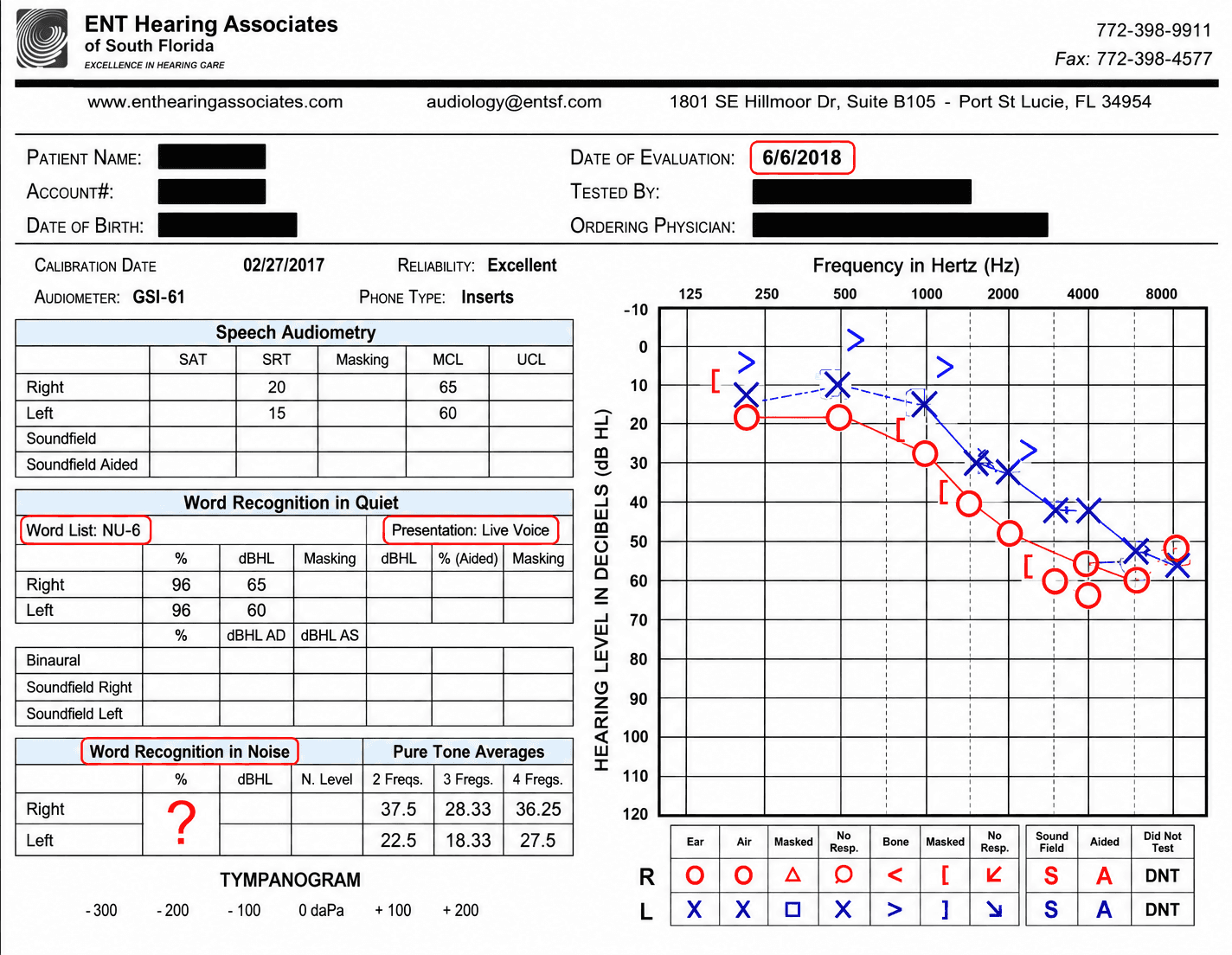
Figure 1. Louise’s Audiogram from 2018. Limited booth testing, only tested speech in quiet, no binaural speech measures and, most egregiously, used the non-gold standard live voice for word recognition.
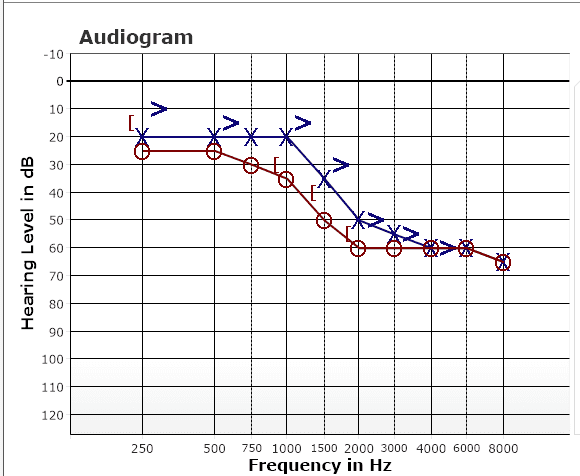

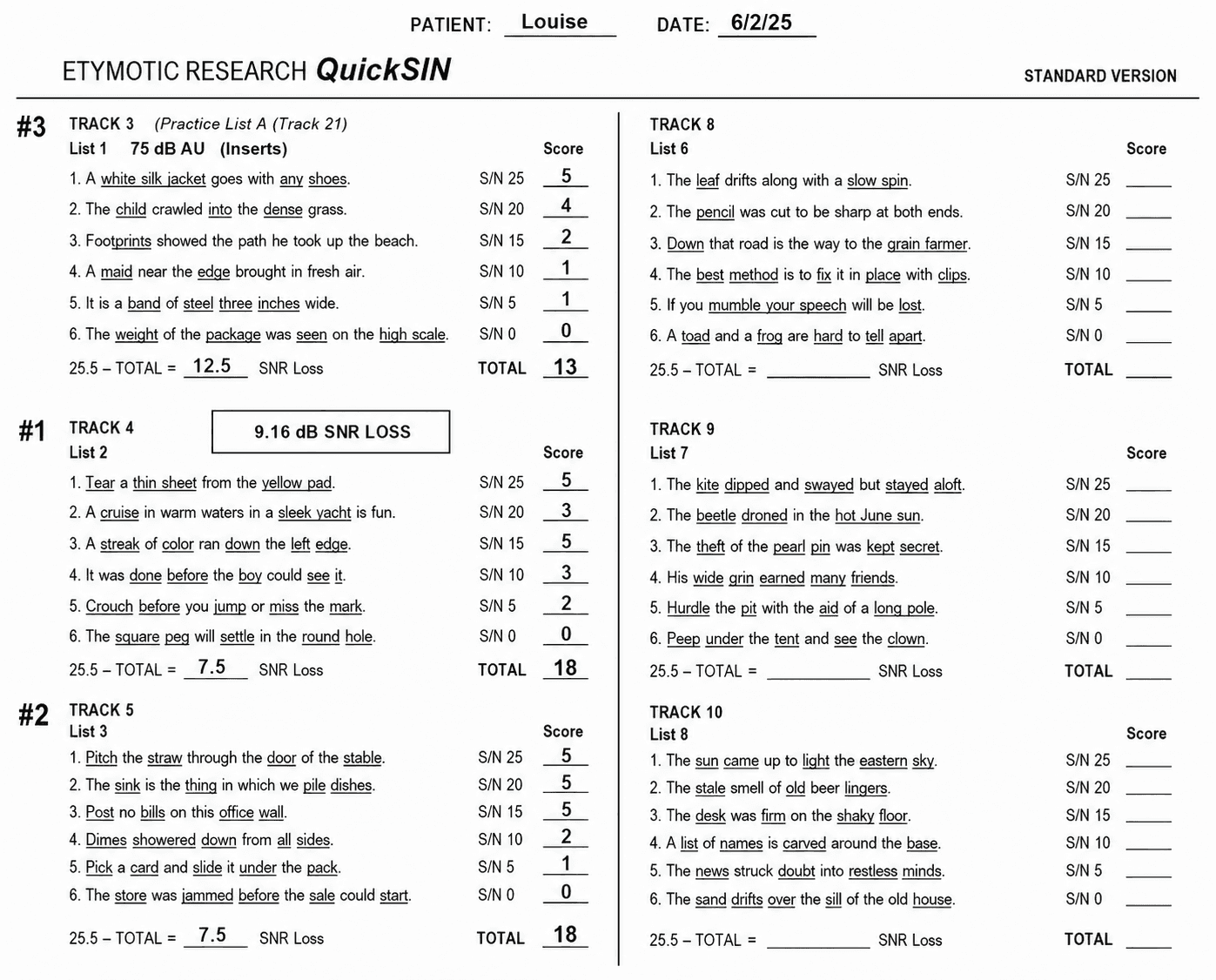
Figure 2: Louise’s Audiogram & QuickSIN. Results validate her struggles with speech clarity, especially consonants and in background noise and confirm her candidacy for hearing aids
Equally important, her test results and auditory potential were clearly explained, helping her understand what was realistically achievable. Regarding her initial appointment with Visalia Hearing Center, she stated, “I got the distinct feeling that they were really trying to understand me, my hearing challenges and what my options were. I arrived thinking they just wanted to sell me something but that was definitely not the case.”
Although Louise believed she had reached her “full potential” with hearing aids (in part because that’s what Eargo had told her), her real-world experience suggested otherwise. At Visalia Hearing Center, she finally obtained objective information to confirm her suspicions. See Figure 3 below for details.

Figure 3: Speech Mapping with Louise’s previous hearing aids. This objective assessment confirms that the Eargo 7 hearing aids are helping but are nowhere close to optimized.
Objective verification (probe microphone/real ear measurement with Speech Mapping) revealed that her previous hearing aids provided only partial access to conversational speech. These deficits in her hearing aids are what limited her confidence and enjoyment in social situations. It is unknown if her poor hearing aid performance was due to a defect in the hearing aid hardware or due to lazy hearing aid programming. The bottom line is Louise’s hearing was not optimized with her internet purchased devices, and better solutions are available.
Personalized Technology & Fitting
Based on the findings from Louise’s deep-dive auditory system analysis and her hearing care goals and preferences, she was fit with a set of prescriptive premium custom hearing aids. Her fitting appointment, like all of the fitting appointments at Visalia Hearing Center, was scheduled for 90 minutes. On a side note: Yes, a personalized fitting that incorporates real ear verification and a through hearing aid orientation (program review, insertion, cleaning, charging, Smart Phone App, Bluetooth pairing, realistic expectations etc.) takes this long. In fact, even a 49-year-old male who was fit in April of 2026 took the entire 90-minutes before he was ready to leave.
As Ronald Reagan popularized, trust but verify. We extend this philosophy to all our manufacturing partners' technologies and our hearing aid fittings. The first step, which is completed before the patient’s fitting appointment, typically when the hearing aids arrive from the factory, is to perform a quality control assessment on the technology called Electro-Acoustic Analysis (EAA). This measure verifies that there are no hardware defects in the hearing aid. Only after the hardware is verified to be within the manufacturer’s specifications can a hearing aid fitting take place.
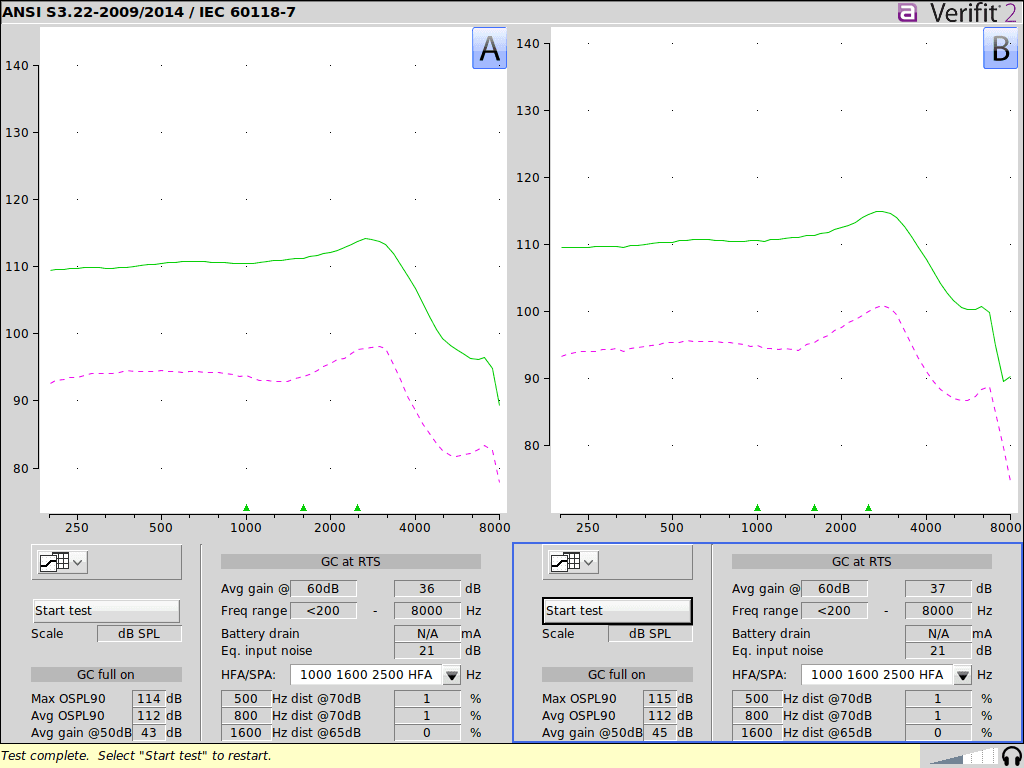
Figure 4: Electro-Acoustic Analysis (EAA) is a quality control measure that verifies the hearing aids that arrive from the manufacturer are functioning within specifications.
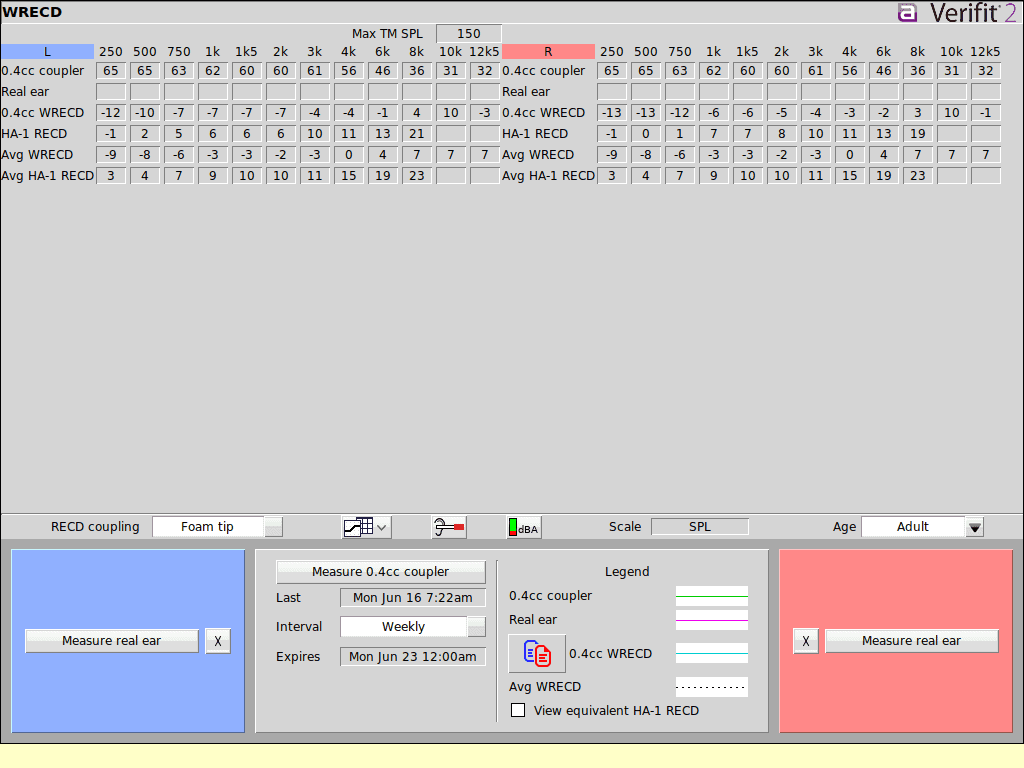
Figure 5: Louise’s Wideband Real-Ear-to-Couple Difference (wRECD).
After Louise’s hearing aids passed the quality control assessment, we moved onto hearing aid optimization. The reality is that no two pairs of ears are the same. Two people could have nearly identical hearing challenges but still need personalized fittings due to the shapes and resonances of their ear canals.
This is where the next measurement, the wRECD comes into play.
The wRECD captures exactly how sound actually resonates in your ears, not how sound resonates in the average adult ear canal, which all the manufacturers use in generating their algorithms. On a side note, of the thousands of ear canals I’ve worked with, do you know how many “average” adult ear canals I’ve encountered? If you guessed zero, you’d be correct. That’s why the wRECD is so important!
The result of incorporating the wRECD into our programming strategy? A personalized fitting for hearing aids that won’t fit anyone else’s hearing profile.
Louise, like all of our patients, deserved the best of the best for her hearing health. Real Ear Measurements made sure that her hearing aids were programmed precisely for her unique hearing loss and ear canal acoustics, ensuring that her new hearing aids are effectively restoring audibility to conversational level speech.
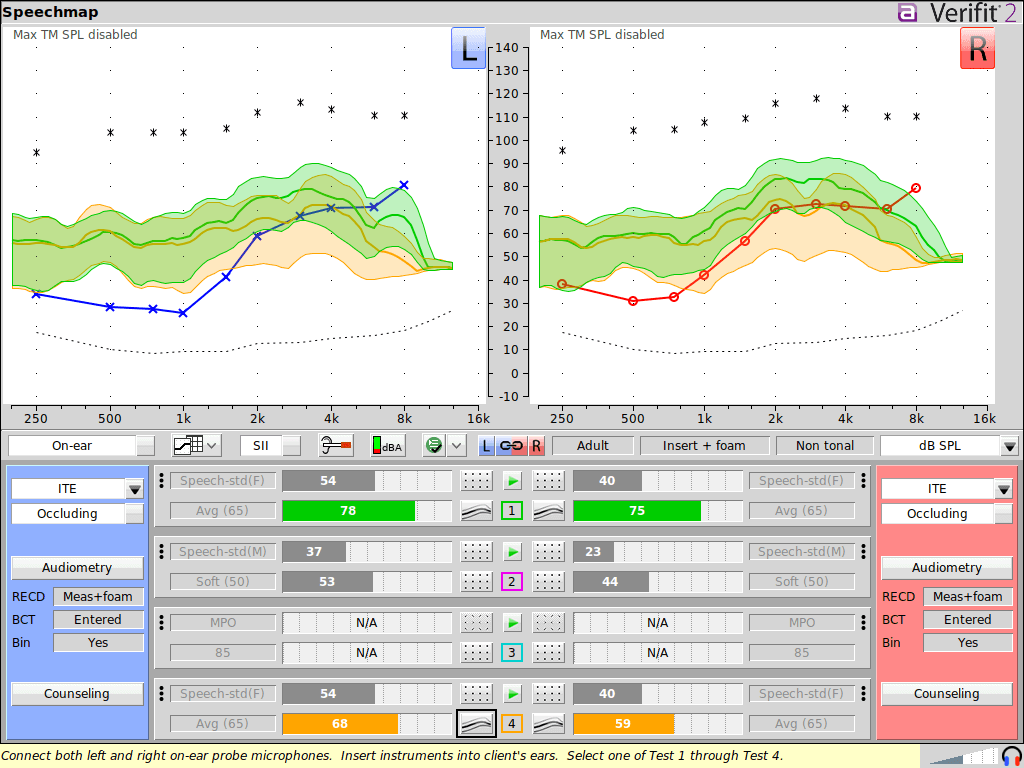
Figure 6: Louise’s Speech Mapping results with Hearing Aids programmed by the experts at Visalia Hearing Center. Check out the difference compared to Figure 2!
To save you from technical jargon, Figure 6 shows Louise’s end results: speech is audible, clear, and comfortable across different inputs. Louise noticed improvement immediately following the fitting. Unlike previous experiences, the programming was tailored to her specific auditory system and designed to optimize speech understanding and comfort in challenging environments.
Verification measures, like Speech Mapping with the VeriFit2, are a key differentiator between practices who really care more about achieving the best outcomes for patients (these types of practices do exist) versus practices who care more about making money for themselves (unfortunately, more of these types of practices exist).
If your hearing care provider is doing real ear verification, they care more about getting your best outcome. If they’re not doing this, they care more about making money for themselves. Choose your hearing care provider carefully.
Outcomes After Optimization
Since beginning her hearing care journey at Visalia Hearing Center, Louise reports:
Wearing her hearing aids approximately 17 hours per day
Improved speech understanding across all environments:
Family conversations: Good
Background noise (restaurants, Quilt Guild meetings): Good
TV and movies: Good, with occasional subtitles
Just better communication everywhere
Hearing better than expected in situations that were previously challenging
No remaining environments she considers problematic
The consistency of daily wear and improved performance reflect both functional benefit and renewed confidence in her devices.
Why Choose Visalia Hearing Center?
Over-the-counter hearing aids can provide some reprieve from hearing challenges, but your experience will be like getting “readers” glasses from the grocery/drug store: adequate for some, not the best for most.
By partnering with expert audiologists who follow the patient-centered healthcare model, you get a tailored experience that better fits your unique needs, not a generic, cookie-cutter-appointment that is great for the “average” person but not so great for any one person in particular.
From our deep dive auditory system analyses and our commitment to objectively verifying all hearing aid fittings , you can rely on our team to understand what you’re going through with your hearing challenges. From Cognitive Screenings to earwax removal, aural rehabilitation , or cochlear implant services and more, you can find everything you need to take care of your auditory system, right here in Visalia, CA.
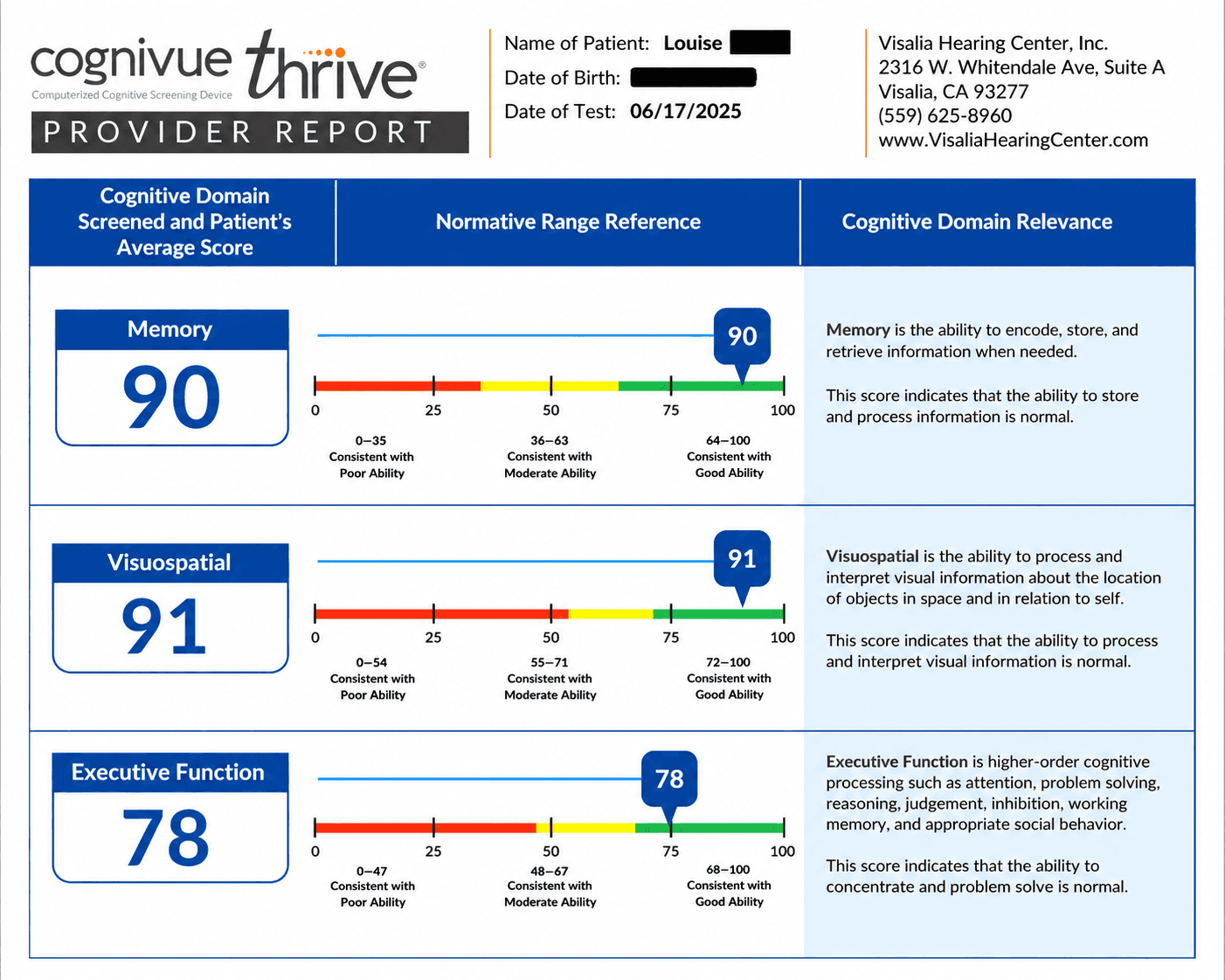
Figure 7. Lousie’s Cognivue Thrive Report 2025. Patients in our bundled care plan can opt into an annual Cognitive screening to ensure we are being as proactive with your healthcare as we can.
Our auditory system comprises both our ears and brain. Everything discussed prior to this would be moot if Louise’s cognition wasn’t performing like it should. As part of our wholistic approach, we check-in annually on our patient’s cognition and will refer out to their primary care doctor if non-age-related changes to cognition are found. Since there are modifiable risk factors for cognitive decline, it’s important that someone is measuring this. We don’t know of any other local hearing care providers that are.
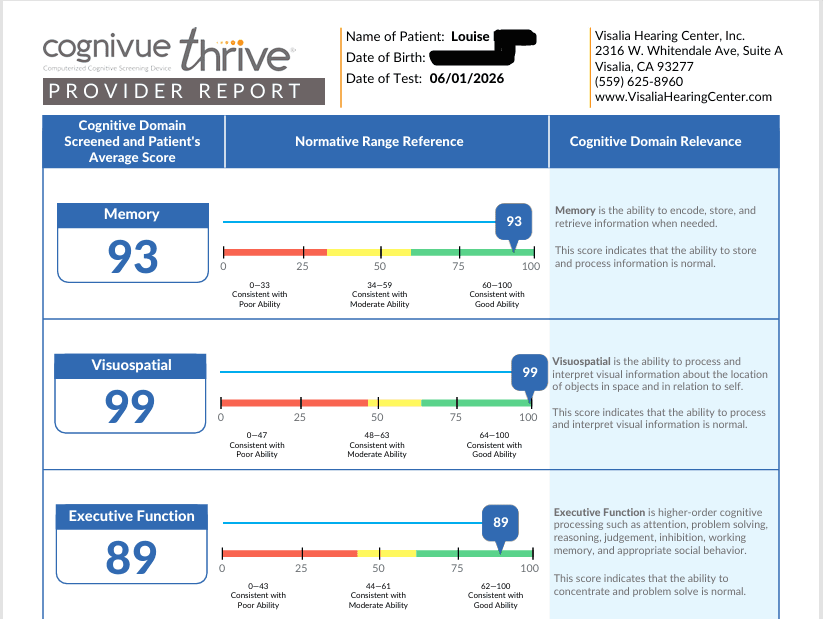
Figure 8 Louise’s 2026 Cognivue Thrive Cognitive Screening. Memory: 93, Visuospatial: 99, Executive Function: 89. All scores consistent with good ability and stable re: 2025.
We don’t just talk the talk; we walk the walk. Figure 8 tells a story that goes well beyond hearing aids. As evidenced by her 2026 Cognitive screening, her results reflect a brain performing at its best. That doesn’t happen by accident, and it doesn’t happen from a one-time device purchase. This is holistic Audiology care.
What you get from Visalia Hearing Center is a long-term partner in your auditory and cognitive health. From your very first appointment to your semi-annual preventative check-ins, we are with you every step of the way, monitoring, adjusting, and proactively watching for changes so that small concerns never become big ones. That is what long-term care actually looks like. And Louise is proof that it works.
Overall Experience & Impact
Louise describes the biggest difference in her hearing as improved clarity of speech and reduction in listening effort, which has significantly increased her enjoyment of social interactions, especially in group settings.
When comparing her experience at Visalia Hearing Center to previous providers, she described the level of care as going “above and beyond”.
She highlighted:
Thorough, detail-oriented examinations
A friendly team that felt genuinely invested in her hearing success
A level of care that went beyond simply providing a device
She would readily recommend Visalia Hearing Center to others struggling with hearing aids, citing the clinic’s comprehensive approach and patient-focused care.
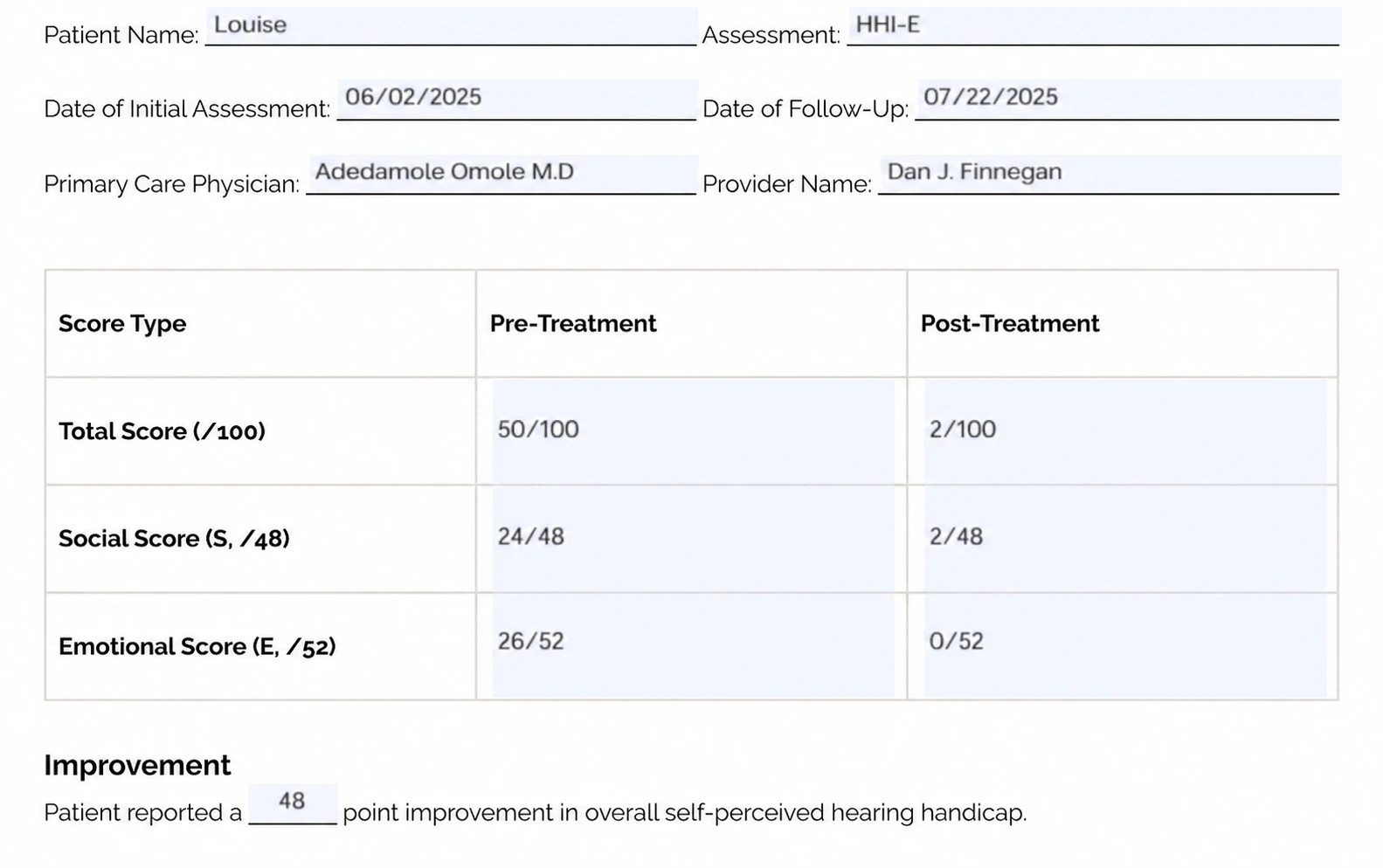
Figure 9: Louise’s Pe & Post optimization HHI-E scores (outcome measure). This is validation that we’ve subjectively improved the patient’s life.
We don’t just have her vote, but we have proof it works. Figure 9 showcases the patient’s Hearing Handicap Inventory HHI-E Outcome Measure, showing her 48-point improvement across all scores.
It doesn’t take rocket science, just simply following audiological best practices and treating each patient as the unique individual they are, not another set of numbers on an audiogram or a dollar sign to be exploited. By doing things the right way (even if it’ssometimes the longer way), you can see the same lasting results as our patients do.
Patient Takeaways
Reflecting on her journey, Louise shared important insights for others who may feel they have “failed” with hearing aids:
A cheaper product may seem like the better financial choice, but higher-quality expertise, care, and technology are the better solution in the long run.
Part of me wishes I just would have come to in-person care to start but I know that having the previous internet purchased hearing aid experiences helps me appreciate even more what Visalia Hearing Center has done and is doing for me.
Take Home Message:
This in-depth case study demonstrates how a wholistic Audiologic approach with personalized programming, and relationship-driven care can help you move beyond frustration and rediscover confidence in your hearing, especially when previous solutions fell short. Helping patients like Louise is exactly what Visalia Hearing Center is known for.
If you’re finding struggles with your current hearing devices, or you’re looking for a second opinion, don’t hesitate to reach out to us to get the answers you deserve. The most important step in achieving better hearing is choosing the right professionals to partner with.
Case Study #2: From Frustration to Clarity
How Wholistic Audiologic Care Transformed Louise’s Hearing Experience
For four years, Louise did everything right. She bought hearing aids: 2 sets in fact, first the Eargo 5, then the Eargo 7, both from a large online retailer. She wore them every day. She called customer support when they failed. She accepted the explanation that they were "programmed optimally." And still, she struggled.
Her frustrations came down to two things:
Poor performance. The number one reason anyone purchases hearing technology is to address personal hearing challenges. Unfortunately, neither of her OTC HA devices did this with any level of satisfaction. Her husband's voice across the dinner table, especially in any restaurant, was still unclear. During her monthly quilting group, where forty women have sewing machines running, she still couldn't participate in the group conversations. The places she loved most were the places she struggled most.
Poor reliability. Repeated device failures, charging issues, batteries that degraded so quickly she couldn't make it through a full day. Warranty support was responsive, and the customer service was, in her words, "very nice" but responsive isn't the same as resolved.
The devices did improve her hearing, somewhat. But neither set gave her confidence. Neither gave her reliability. And after four years of being told the aids were programmed optimally while knowing her experience told a different story, she decided enough was enough.
After a Duck Duck Go search for local hearing care, she found Visalia Hearing Center, and for the first time, decided to put her hearing in the hands of an American Board of Audiology Certified audiologist, and the difference was immediate.
A Different Approach to Hearing Care
From the initial visit, Louise noticed that Visalia Hearing Center’s process was unlike anything she had experienced before. She’d had a hearing test at a doctor’s office and an online test with Eargo before but nothing like this.
What she received was:
Extensive in-booth testing: while it seemed her previous testing tried to get her out of the booth as quickly as possible, she had 45-minutes of non-stop hearing measurements taken at Visalia Hearing Center. On a side note, while extra assessments might seem time-consuming, these detailed evaluations provide the insight needed for patients to succeed. If your Audiologist doesn’t fully understand what’s going on with your auditory system, how can they possibly find the best solution to remedy it?
Speech-in-noise testing that simulated real-world listening challenges: Louise described this assessment as “exactly what it’s like” in the real world and that was the first time anyone had tried to really understand me. Per Louise, “I kept telling them (the company she bought them from) I am struggling to understand when there’s background noise and all they did was repeatedly ask me to push a button for beeps... in quiet.”
An objective analysis of her current internet purchased OTC hearing aids that confirmed and validated her frustrations with lack of hearing benefit: “I kept telling them (the company she bought them from) I’m not hearing well and I was repeatedly told the devices were program optimally. They almost made me feel it was my fault I wasn’t hearing well. It is clear now that wasn’t my fault, it was the poor programming of the hearing aids.”
Figure 1. Louise’s Audiogram from 2018. Limited booth testing, only tested speech in quiet, no binaural speech measures and, most egregiously, used the non-gold standard live voice for word recognition.
Figure 2: Louise’s Audiogram & QuickSIN. Results validate her struggles with speech clarity, especially consonants and in background noise and confirm her candidacy for hearing aids
Equally important, her test results and auditory potential were clearly explained, helping her understand what was realistically achievable. Regarding her initial appointment with Visalia Hearing Center, she stated, “I got the distinct feeling that they were really trying to understand me, my hearing challenges and what my options were. I arrived thinking they just wanted to sell me something but that was definitely not the case.”
Although Louise believed she had reached her “full potential” with hearing aids (in part because that’s what Eargo had told her), her real-world experience suggested otherwise. At Visalia Hearing Center, she finally obtained objective information to confirm her suspicions. See Figure 3 below for details.
Figure 3: Speech Mapping with Louise’s previous hearing aids. This objective assessment confirms that the Eargo 7 hearing aids are helping but are nowhere close to optimized.
Objective verification (probe microphone/real ear measurement with Speech Mapping) revealed that her previous hearing aids provided only partial access to conversational speech. These deficits in her hearing aids are what limited her confidence and enjoyment in social situations. It is unknown if her poor hearing aid performance was due to a defect in the hearing aid hardware or due to lazy hearing aid programming. The bottom line is Louise’s hearing was not optimized with her internet purchased devices, and better solutions are available.
Personalized Technology & Fitting
Based on the findings from Louise’s deep-dive auditory system analysis and her hearing care goals and preferences, she was fit with a set of prescriptive premium custom hearing aids. Her fitting appointment, like all of the fitting appointments at Visalia Hearing Center, was scheduled for 90 minutes. On a side note: Yes, a personalized fitting that incorporates real ear verification and a through hearing aid orientation (program review, insertion, cleaning, charging, Smart Phone App, Bluetooth pairing, realistic expectations etc.) takes this long. In fact, even a 49-year-old male who was fit in April of 2026 took the entire 90-minutes before he was ready to leave.
As Ronald Reagan popularized, trust but verify. We extend this philosophy to all our manufacturing partners' technologies and our hearing aid fittings. The first step, which is completed before the patient’s fitting appointment, typically when the hearing aids arrive from the factory, is to perform a quality control assessment on the technology called Electro-Acoustic Analysis (EAA). This measure verifies that there are no hardware defects in the hearing aid. Only after the hardware is verified to be within the manufacturer’s specifications can a hearing aid fitting take place.
Figure 4: Electro-Acoustic Analysis (EAA) is a quality control measure that verifies the hearing aids that arrive from the manufacturer are functioning within specifications.
Figure 5: Louise’s Wideband Real-Ear-to-Couple Difference (wRECD).
After Louise’s hearing aids passed the quality control assessment, we moved onto hearing aid optimization. The reality is that no two pairs of ears are the same. Two people could have nearly identical hearing challenges but still need personalized fittings due to the shapes and resonances of their ear canals.
This is where the next measurement, the wRECD comes into play.
The wRECD captures exactly how sound actually resonates in your ears, not how sound resonates in the average adult ear canal, which all the manufacturers use in generating their algorithms. On a side note, of the thousands of ear canals I’ve worked with, do you know how many “average” adult ear canals I’ve encountered? If you guessed zero, you’d be correct. That’s why the wRECD is so important!
The result of incorporating the wRECD into our programming strategy? A personalized fitting for hearing aids that won’t fit anyone else’s hearing profile.
Louise, like all of our patients, deserved the best of the best for her hearing health. Real Ear Measurements made sure that her hearing aids were programmed precisely for her unique hearing loss and ear canal acoustics, ensuring that her new hearing aids are effectively restoring audibility to conversational level speech.
Figure 6: Louise’s Speech Mapping results with Hearing Aids programmed by the experts at Visalia Hearing Center. Check out the difference compared to Figure 2!
To save you from technical jargon, Figure 6 shows Louise’s end results: speech is audible, clear, and comfortable across different inputs. Louise noticed improvement immediately following the fitting. Unlike previous experiences, the programming was tailored to her specific auditory system and designed to optimize speech understanding and comfort in challenging environments.
Verification measures, like Speech Mapping with the VeriFit2, are a key differentiator between practices who really care more about achieving the best outcomes for patients (these types of practices do exist) versus practices who care more about making money for themselves (unfortunately, more of these types of practices exist).
If your hearing care provider is doing real ear verification, they care more about getting your best outcome. If they’re not doing this, they care more about making money for themselves. Choose your hearing care provider carefully.
Outcomes After Optimization
Since beginning her hearing care journey at Visalia Hearing Center, Louise reports:
Wearing her hearing aids approximately 17 hours per day
Improved speech understanding across all environments:
Family conversations: Good
Background noise (restaurants, Quilt Guild meetings): Good
TV and movies: Good, with occasional subtitles
Just better communication everywhere
Hearing better than expected in situations that were previously challenging
No remaining environments she considers problematic
The consistency of daily wear and improved performance reflect both functional benefit and renewed confidence in her devices.
Why Choose Visalia Hearing Center?
Over-the-counter hearing aids can provide some reprieve from hearing challenges, but your experience will be like getting “readers” glasses from the grocery/drug store: adequate for some, not the best for most.
By partnering with expert audiologists who follow the patient-centered healthcare model, you get a tailored experience that better fits your unique needs, not a generic, cookie-cutter-appointment that is great for the “average” person but not so great for any one person in particular.
From our deep dive auditory system analyses and our commitment to objectively verifying all hearing aid fittings , you can rely on our team to understand what you’re going through with your hearing challenges. From Cognitive Screenings to earwax removal, aural rehabilitation , or cochlear implant services and more, you can find everything you need to take care of your auditory system, right here in Visalia, CA.
Figure 7. Lousie’s Cognivue Thrive Report 2025. Patients in our bundled care plan can opt into an annual Cognitive screening to ensure we are being as proactive with your healthcare as we can.
Our auditory system comprises both our ears and brain. Everything discussed prior to this would be moot if Louise’s cognition wasn’t performing like it should. As part of our wholistic approach, we check-in annually on our patient’s cognition and will refer out to their primary care doctor if non-age-related changes to cognition are found. Since there are modifiable risk factors for cognitive decline, it’s important that someone is measuring this. We don’t know of any other local hearing care providers that are.
Figure 8 Louise’s 2026 Cognivue Thrive Cognitive Screening. Memory: 93, Visuospatial: 99, Executive Function: 89. All scores consistent with good ability and stable re: 2025.
We don’t just talk the talk; we walk the walk. Figure 8 tells a story that goes well beyond hearing aids. As evidenced by her 2026 Cognitive screening, her results reflect a brain performing at its best. That doesn’t happen by accident, and it doesn’t happen from a one-time device purchase. This is holistic Audiology care.
What you get from Visalia Hearing Center is a long-term partner in your auditory and cognitive health. From your very first appointment to your semi-annual preventative check-ins, we are with you every step of the way, monitoring, adjusting, and proactively watching for changes so that small concerns never become big ones. That is what long-term care actually looks like. And Louise is proof that it works.
Overall Experience & Impact
Louise describes the biggest difference in her hearing as improved clarity of speech and reduction in listening effort, which has significantly increased her enjoyment of social interactions, especially in group settings.
When comparing her experience at Visalia Hearing Center to previous providers, she described the level of care as going “above and beyond”.
She highlighted:
Thorough, detail-oriented examinations
A friendly team that felt genuinely invested in her hearing success
A level of care that went beyond simply providing a device
She would readily recommend Visalia Hearing Center to others struggling with hearing aids, citing the clinic’s comprehensive approach and patient-focused care.
Figure 9: Louise’s Pe & Post optimization HHI-E scores (outcome measure). This is validation that we’ve subjectively improved the patient’s life.
We don’t just have her vote, but we have proof it works. Figure 9 showcases the patient’s Hearing Handicap Inventory HHI-E Outcome Measure, showing her 48-point improvement across all scores.
It doesn’t take rocket science, just simply following audiological best practices and treating each patient as the unique individual they are, not another set of numbers on an audiogram or a dollar sign to be exploited. By doing things the right way (even if it’ssometimes the longer way), you can see the same lasting results as our patients do.
Patient Takeaways
Reflecting on her journey, Louise shared important insights for others who may feel they have “failed” with hearing aids:
A cheaper product may seem like the better financial choice, but higher-quality expertise, care, and technology are the better solution in the long run.
Part of me wishes I just would have come to in-person care to start but I know that having the previous internet purchased hearing aid experiences helps me appreciate even more what Visalia Hearing Center has done and is doing for me.
Take Home Message:
This in-depth case study demonstrates how a wholistic Audiologic approach with personalized programming, and relationship-driven care can help you move beyond frustration and rediscover confidence in your hearing, especially when previous solutions fell short. Helping patients like Louise is exactly what Visalia Hearing Center is known for.
If you’re finding struggles with your current hearing devices, or you’re looking for a second opinion, don’t hesitate to reach out to us to get the answers you deserve. The most important step in achieving better hearing is choosing the right professionals to partner with.
Case Study #2: From Frustration to Clarity
How Wholistic Audiologic Care Transformed Louise’s Hearing Experience
For four years, Louise did everything right. She bought hearing aids: 2 sets in fact, first the Eargo 5, then the Eargo 7, both from a large online retailer. She wore them every day. She called customer support when they failed. She accepted the explanation that they were "programmed optimally." And still, she struggled.
Her frustrations came down to two things:
Poor performance. The number one reason anyone purchases hearing technology is to address personal hearing challenges. Unfortunately, neither of her OTC HA devices did this with any level of satisfaction. Her husband's voice across the dinner table, especially in any restaurant, was still unclear. During her monthly quilting group, where forty women have sewing machines running, she still couldn't participate in the group conversations. The places she loved most were the places she struggled most.
Poor reliability. Repeated device failures, charging issues, batteries that degraded so quickly she couldn't make it through a full day. Warranty support was responsive, and the customer service was, in her words, "very nice" but responsive isn't the same as resolved.
The devices did improve her hearing, somewhat. But neither set gave her confidence. Neither gave her reliability. And after four years of being told the aids were programmed optimally while knowing her experience told a different story, she decided enough was enough.
After a Duck Duck Go search for local hearing care, she found Visalia Hearing Center, and for the first time, decided to put her hearing in the hands of an American Board of Audiology Certified audiologist, and the difference was immediate.
A Different Approach to Hearing Care
From the initial visit, Louise noticed that Visalia Hearing Center’s process was unlike anything she had experienced before. She’d had a hearing test at a doctor’s office and an online test with Eargo before but nothing like this.
What she received was:
Extensive in-booth testing: while it seemed her previous testing tried to get her out of the booth as quickly as possible, she had 45-minutes of non-stop hearing measurements taken at Visalia Hearing Center. On a side note, while extra assessments might seem time-consuming, these detailed evaluations provide the insight needed for patients to succeed. If your Audiologist doesn’t fully understand what’s going on with your auditory system, how can they possibly find the best solution to remedy it?
Speech-in-noise testing that simulated real-world listening challenges: Louise described this assessment as “exactly what it’s like” in the real world and that was the first time anyone had tried to really understand me. Per Louise, “I kept telling them (the company she bought them from) I am struggling to understand when there’s background noise and all they did was repeatedly ask me to push a button for beeps... in quiet.”
An objective analysis of her current internet purchased OTC hearing aids that confirmed and validated her frustrations with lack of hearing benefit: “I kept telling them (the company she bought them from) I’m not hearing well and I was repeatedly told the devices were program optimally. They almost made me feel it was my fault I wasn’t hearing well. It is clear now that wasn’t my fault, it was the poor programming of the hearing aids.”
Figure 1. Louise’s Audiogram from 2018. Limited booth testing, only tested speech in quiet, no binaural speech measures and, most egregiously, used the non-gold standard live voice for word recognition.
Figure 2: Louise’s Audiogram & QuickSIN. Results validate her struggles with speech clarity, especially consonants and in background noise and confirm her candidacy for hearing aids
Equally important, her test results and auditory potential were clearly explained, helping her understand what was realistically achievable. Regarding her initial appointment with Visalia Hearing Center, she stated, “I got the distinct feeling that they were really trying to understand me, my hearing challenges and what my options were. I arrived thinking they just wanted to sell me something but that was definitely not the case.”
Although Louise believed she had reached her “full potential” with hearing aids (in part because that’s what Eargo had told her), her real-world experience suggested otherwise. At Visalia Hearing Center, she finally obtained objective information to confirm her suspicions. See Figure 3 below for details.
Figure 3: Speech Mapping with Louise’s previous hearing aids. This objective assessment confirms that the Eargo 7 hearing aids are helping but are nowhere close to optimized.
Objective verification (probe microphone/real ear measurement with Speech Mapping) revealed that her previous hearing aids provided only partial access to conversational speech. These deficits in her hearing aids are what limited her confidence and enjoyment in social situations. It is unknown if her poor hearing aid performance was due to a defect in the hearing aid hardware or due to lazy hearing aid programming. The bottom line is Louise’s hearing was not optimized with her internet purchased devices, and better solutions are available.
Personalized Technology & Fitting
Based on the findings from Louise’s deep-dive auditory system analysis and her hearing care goals and preferences, she was fit with a set of prescriptive premium custom hearing aids. Her fitting appointment, like all of the fitting appointments at Visalia Hearing Center, was scheduled for 90 minutes. On a side note: Yes, a personalized fitting that incorporates real ear verification and a through hearing aid orientation (program review, insertion, cleaning, charging, Smart Phone App, Bluetooth pairing, realistic expectations etc.) takes this long. In fact, even a 49-year-old male who was fit in April of 2026 took the entire 90-minutes before he was ready to leave.
As Ronald Reagan popularized, trust but verify. We extend this philosophy to all our manufacturing partners' technologies and our hearing aid fittings. The first step, which is completed before the patient’s fitting appointment, typically when the hearing aids arrive from the factory, is to perform a quality control assessment on the technology called Electro-Acoustic Analysis (EAA). This measure verifies that there are no hardware defects in the hearing aid. Only after the hardware is verified to be within the manufacturer’s specifications can a hearing aid fitting take place.
Figure 4: Electro-Acoustic Analysis (EAA) is a quality control measure that verifies the hearing aids that arrive from the manufacturer are functioning within specifications.
Figure 5: Louise’s Wideband Real-Ear-to-Couple Difference (wRECD).
After Louise’s hearing aids passed the quality control assessment, we moved onto hearing aid optimization. The reality is that no two pairs of ears are the same. Two people could have nearly identical hearing challenges but still need personalized fittings due to the shapes and resonances of their ear canals.
This is where the next measurement, the wRECD comes into play.
The wRECD captures exactly how sound actually resonates in your ears, not how sound resonates in the average adult ear canal, which all the manufacturers use in generating their algorithms. On a side note, of the thousands of ear canals I’ve worked with, do you know how many “average” adult ear canals I’ve encountered? If you guessed zero, you’d be correct. That’s why the wRECD is so important!
The result of incorporating the wRECD into our programming strategy? A personalized fitting for hearing aids that won’t fit anyone else’s hearing profile.
Louise, like all of our patients, deserved the best of the best for her hearing health. Real Ear Measurements made sure that her hearing aids were programmed precisely for her unique hearing loss and ear canal acoustics, ensuring that her new hearing aids are effectively restoring audibility to conversational level speech.
Figure 6: Louise’s Speech Mapping results with Hearing Aids programmed by the experts at Visalia Hearing Center. Check out the difference compared to Figure 2!
To save you from technical jargon, Figure 6 shows Louise’s end results: speech is audible, clear, and comfortable across different inputs. Louise noticed improvement immediately following the fitting. Unlike previous experiences, the programming was tailored to her specific auditory system and designed to optimize speech understanding and comfort in challenging environments.
Verification measures, like Speech Mapping with the VeriFit2, are a key differentiator between practices who really care more about achieving the best outcomes for patients (these types of practices do exist) versus practices who care more about making money for themselves (unfortunately, more of these types of practices exist).
If your hearing care provider is doing real ear verification, they care more about getting your best outcome. If they’re not doing this, they care more about making money for themselves. Choose your hearing care provider carefully.
Outcomes After Optimization
Since beginning her hearing care journey at Visalia Hearing Center, Louise reports:
Wearing her hearing aids approximately 17 hours per day
Improved speech understanding across all environments:
Family conversations: Good
Background noise (restaurants, Quilt Guild meetings): Good
TV and movies: Good, with occasional subtitles
Just better communication everywhere
Hearing better than expected in situations that were previously challenging
No remaining environments she considers problematic
The consistency of daily wear and improved performance reflect both functional benefit and renewed confidence in her devices.
Why Choose Visalia Hearing Center?
Over-the-counter hearing aids can provide some reprieve from hearing challenges, but your experience will be like getting “readers” glasses from the grocery/drug store: adequate for some, not the best for most.
By partnering with expert audiologists who follow the patient-centered healthcare model, you get a tailored experience that better fits your unique needs, not a generic, cookie-cutter-appointment that is great for the “average” person but not so great for any one person in particular.
From our deep dive auditory system analyses and our commitment to objectively verifying all hearing aid fittings , you can rely on our team to understand what you’re going through with your hearing challenges. From Cognitive Screenings to earwax removal, aural rehabilitation , or cochlear implant services and more, you can find everything you need to take care of your auditory system, right here in Visalia, CA.
Figure 7. Lousie’s Cognivue Thrive Report 2025. Patients in our bundled care plan can opt into an annual Cognitive screening to ensure we are being as proactive with your healthcare as we can.
Our auditory system comprises both our ears and brain. Everything discussed prior to this would be moot if Louise’s cognition wasn’t performing like it should. As part of our wholistic approach, we check-in annually on our patient’s cognition and will refer out to their primary care doctor if non-age-related changes to cognition are found. Since there are modifiable risk factors for cognitive decline, it’s important that someone is measuring this. We don’t know of any other local hearing care providers that are.
Figure 8 Louise’s 2026 Cognivue Thrive Cognitive Screening. Memory: 93, Visuospatial: 99, Executive Function: 89. All scores consistent with good ability and stable re: 2025.
We don’t just talk the talk; we walk the walk. Figure 8 tells a story that goes well beyond hearing aids. As evidenced by her 2026 Cognitive screening, her results reflect a brain performing at its best. That doesn’t happen by accident, and it doesn’t happen from a one-time device purchase. This is holistic Audiology care.
What you get from Visalia Hearing Center is a long-term partner in your auditory and cognitive health. From your very first appointment to your semi-annual preventative check-ins, we are with you every step of the way, monitoring, adjusting, and proactively watching for changes so that small concerns never become big ones. That is what long-term care actually looks like. And Louise is proof that it works.
Overall Experience & Impact
Louise describes the biggest difference in her hearing as improved clarity of speech and reduction in listening effort, which has significantly increased her enjoyment of social interactions, especially in group settings.
When comparing her experience at Visalia Hearing Center to previous providers, she described the level of care as going “above and beyond”.
She highlighted:
Thorough, detail-oriented examinations
A friendly team that felt genuinely invested in her hearing success
A level of care that went beyond simply providing a device
She would readily recommend Visalia Hearing Center to others struggling with hearing aids, citing the clinic’s comprehensive approach and patient-focused care.
Figure 9: Louise’s Pe & Post optimization HHI-E scores (outcome measure). This is validation that we’ve subjectively improved the patient’s life.
We don’t just have her vote, but we have proof it works. Figure 9 showcases the patient’s Hearing Handicap Inventory HHI-E Outcome Measure, showing her 48-point improvement across all scores.
It doesn’t take rocket science, just simply following audiological best practices and treating each patient as the unique individual they are, not another set of numbers on an audiogram or a dollar sign to be exploited. By doing things the right way (even if it’ssometimes the longer way), you can see the same lasting results as our patients do.
Patient Takeaways
Reflecting on her journey, Louise shared important insights for others who may feel they have “failed” with hearing aids:
A cheaper product may seem like the better financial choice, but higher-quality expertise, care, and technology are the better solution in the long run.
Part of me wishes I just would have come to in-person care to start but I know that having the previous internet purchased hearing aid experiences helps me appreciate even more what Visalia Hearing Center has done and is doing for me.
Take Home Message:
This in-depth case study demonstrates how a wholistic Audiologic approach with personalized programming, and relationship-driven care can help you move beyond frustration and rediscover confidence in your hearing, especially when previous solutions fell short. Helping patients like Louise is exactly what Visalia Hearing Center is known for.
If you’re finding struggles with your current hearing devices, or you’re looking for a second opinion, don’t hesitate to reach out to us to get the answers you deserve. The most important step in achieving better hearing is choosing the right professionals to partner with.
Your Questions Answered
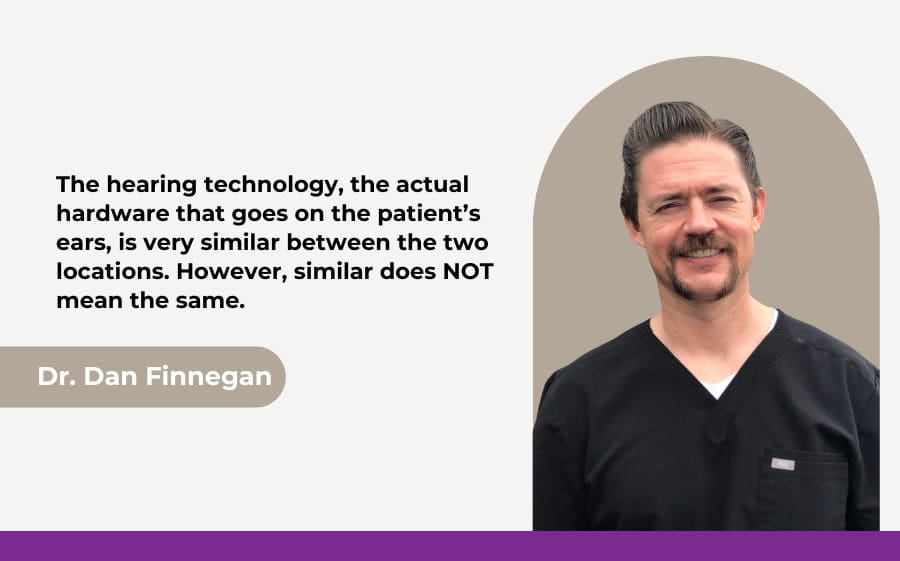

50% of $0 Is Still $0: How Some Insurance Companies Hide the Truth About Hearing Care Coverage

|
Dr. Dan Finnegan
|
Sep 22, 2026

What Doing "Audiologic Best Practices" Actually Looks Like: The Gold Standard in Action
|
Dr. Dan Finnegan
|
Sep 1, 2026
Here’s exactly how those best practices break down and why doing the basics right changes everything.
Your Questions Answered
50% of $0 Is Still $0: How Some Insurance Companies Hide the Truth About Hearing Care Coverage
|
Dr. Dan Finnegan
|
Sep 22, 2026
What Doing "Audiologic Best Practices" Actually Looks Like: The Gold Standard in Action
|
Dr. Dan Finnegan
|
Sep 1, 2026
Here’s exactly how those best practices break down and why doing the basics right changes everything.
Your Questions Answered
Request a Callback
Many of our patients wish that they had contacted us a long time prior to the moment that they did.
If you’re ready to start your hearing journey or would like to schedule an appointment, then you can either call the number below or complete the form on this page.
Don’t want to wait? Call Us at 559-625-8960
Request a Callback
Many of our patients wish that they had contacted us a long time prior to the moment that they did.
If you’re ready to start your hearing journey or would like to schedule an appointment, then you can either call the number below or complete the form on this page.
Don’t want to wait? Call Us at 559-625-8960
Request a Callback
Many of our patients wish that they had contacted us a long time prior to the moment that they did.
If you’re ready to start your hearing journey or would like to schedule an appointment, then you can either call the number below or complete the form on this page.
Don’t want to wait? Call Us at 559-625-8960
Setting Benchmarks of Audiological Excellence
Contact us
Mon-Thurs: 8:30am – 5pm
Fri: 8am – Noon
Setting Benchmarks of Audiological Excellence
Contact us
Mon-Thurs: 8:30am – 5pm
Fri: 8am – Noon
Setting Benchmarks of Audiological Excellence
Contact us
Mon-Thurs: 8:30am – 5pm
Fri: 8am – Noon