
Understanding the Link: Hearing Loss and Cognitive Decline
There’s a lot of talk these days about how untreated hearing loss can impact more than just your ability to follow conversations. In fact, hearing loss is now recognized as one of the 14 modifiable risk factors for cognitive decline.
But what does “modifiable risk factor” actually mean? Simply put, it’s something you can change to help reduce your risk of cognitive issues down the line.
To bring this idea to life, we want to share Elizabeth’s story. Her journey is a real-world example of how taking charge of your hearing health can lead to measurable, life-changing results.
Meet Elizabeth: A Decades-Long Hearing Aid User
Elizabeth is 81 years young and has been wearing prescriptive hearing aids for over 20 years. Like many long-term hearing aid users, she’s experienced the many ups and downs of hearing technology.
Elizabeth came to our team at Visalia Hearing Center looking for an upgrade to her hearing aids and, more importantly, a different approach to her overall hearing care.
The Visalia Hearing Center Approach: More Than Just Hearing Aids
When Elizabeth joined us, she enrolled in our bundled care package, which includes so much more than just fitting new devices. One of the standout features of our bundled care package is annual cognitive screenings with the Cognivue.
Cognivue allows Visalia Hearing Center to get a baseline screening measure of cognitive function, which is typically done at the time of your device fitting. The screening is then performed annually as part of your proactive preventative maintenance program. This allows our team to track any changes to your cognitive health over time and make referrals to other health care experts if significant decreases are discovered (in addition to untreated hearing loss, there are 13 other modifiable risk factors that can be explored to improve/restored cognitive function).
The Numbers Don’t Lie: Elizabeth’s Cognitive Improvements
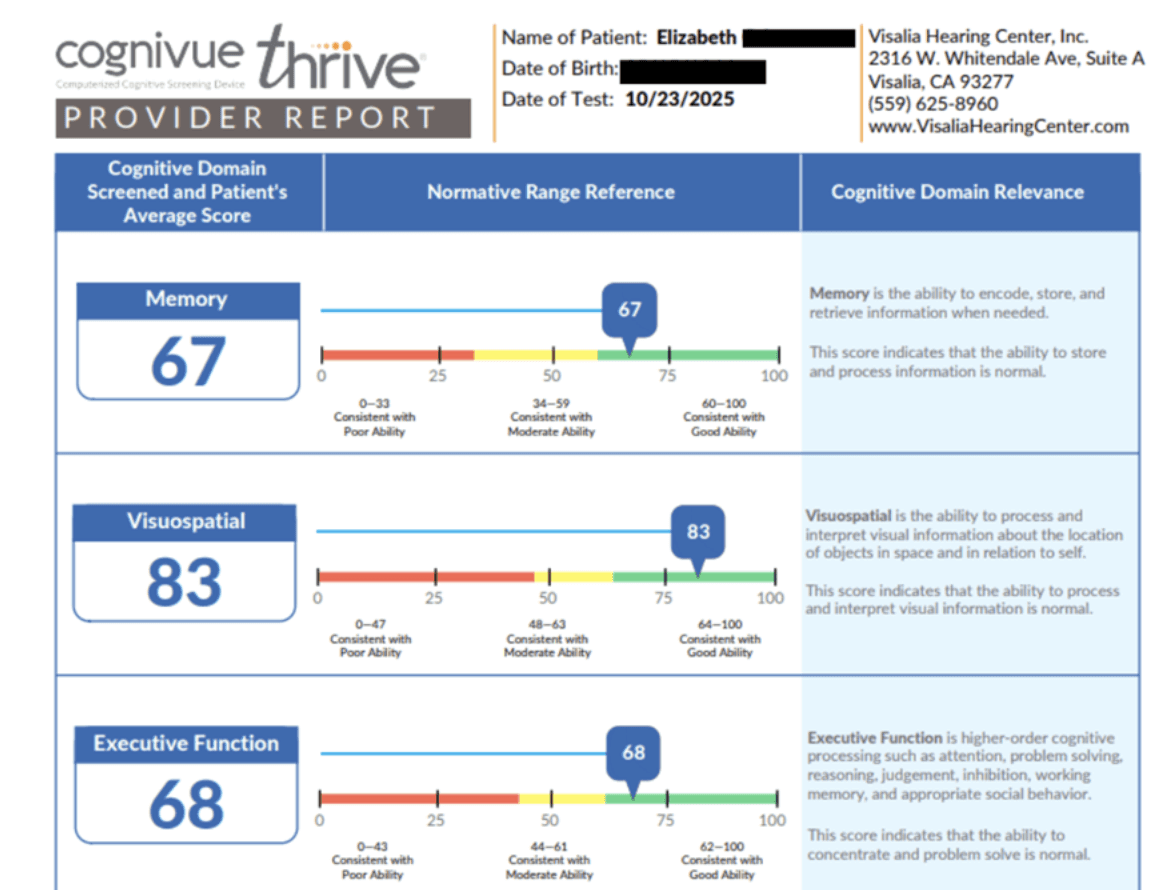
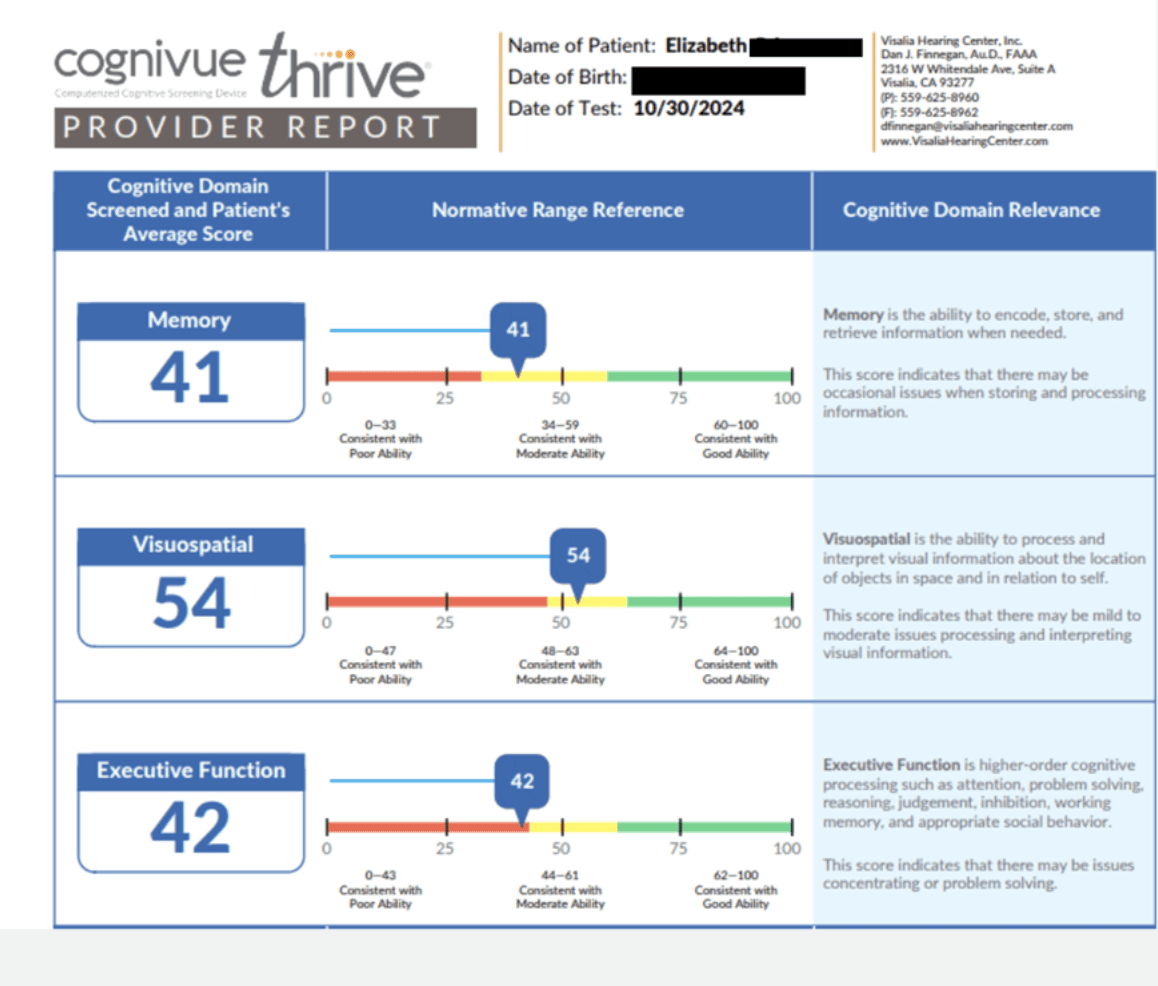
Elizabeth’s results were nothing short of remarkable. Here’s how her cognitive screening scores changed one year after receiving expert care and getting fitted with her personalized hearing aids:
Memory: Improved from 41 to 67
Visuospatial Skills: Improved from 54 to 83
Executive Function: Improved from 42 to 68
To put this in perspective, these scores moved from the “poor” or “moderate” ranges into the “good” range.
That’s not just a small bump; it’s a night-and-day difference.
What’s Behind the Improvement?
You might be wondering, “Did Elizabeth just have a bad day during her first test? Did she suddenly discover the fountain of youth?” The answer is much more grounded: She finally received hearing care that truly met her needs.
While we can’t claim with 100 percent certainty that her cognitive improvements are solely due to our care, the objective data and Elizabeth’s own experiences strongly suggest that effective hearing care was a major contributor to this turn-around.
Objective Data: Speech Intelligibility Index (SII) Scores from Real Ear Verification
Let’s get into the nitty-gritty.
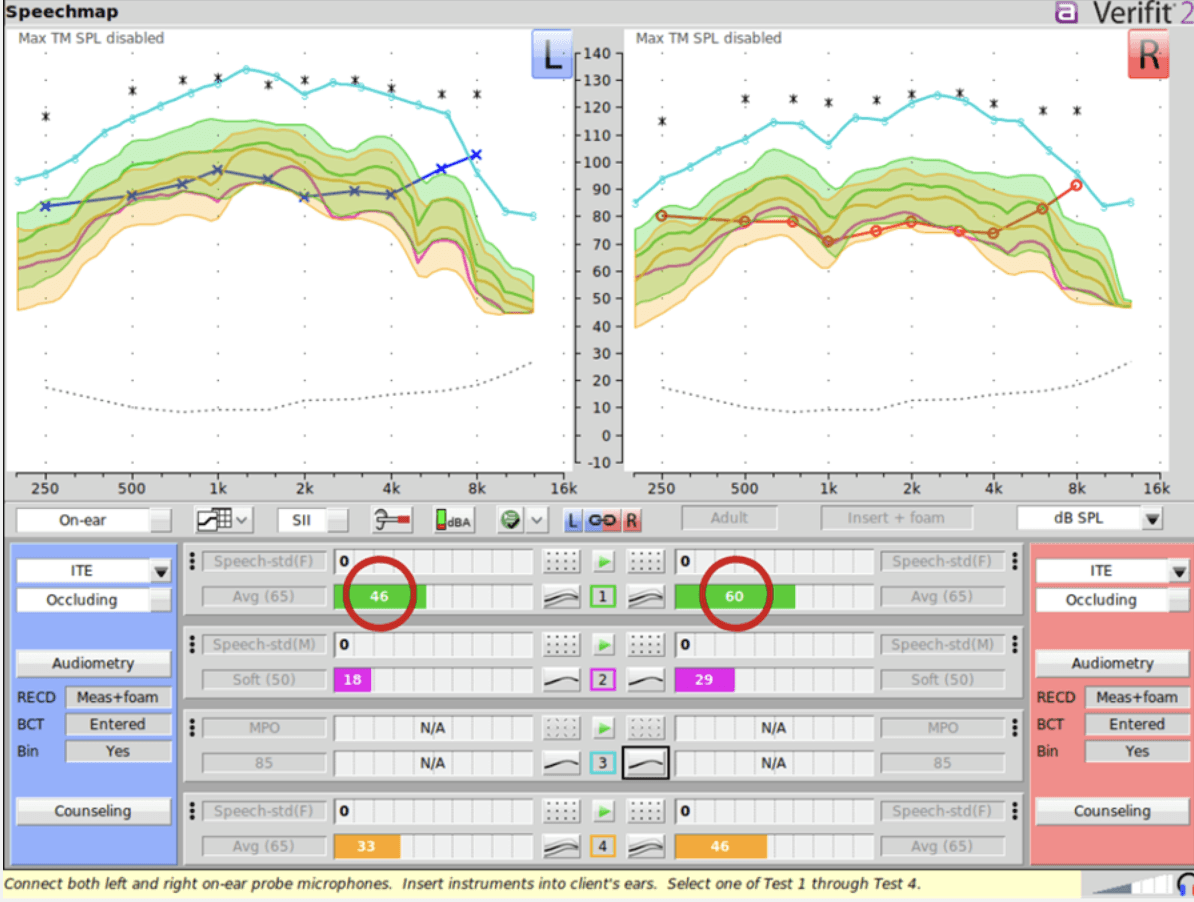
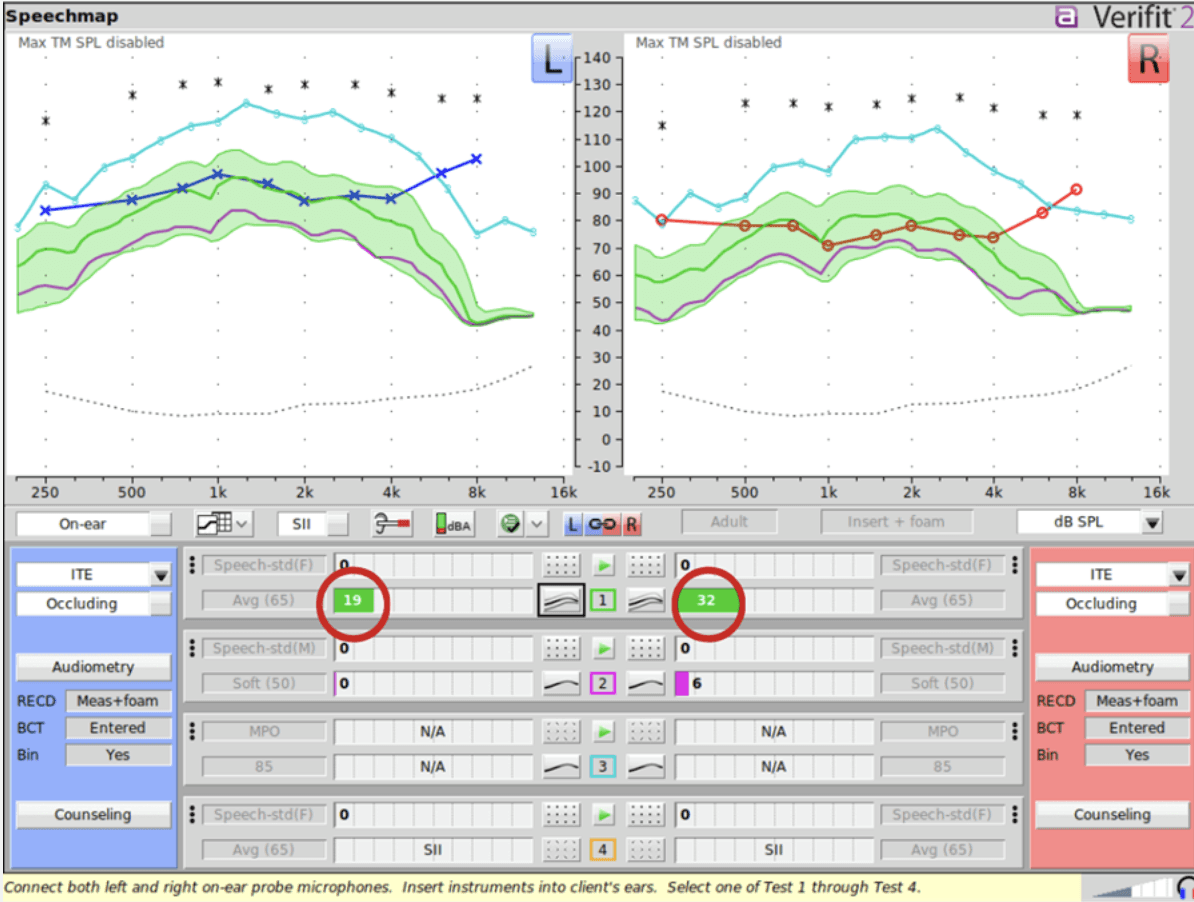
The Speech Intelligibility Index (SII) measures how much speech information is actually reaching the brain. Each score is referenced to a specific input level (i.e. whispered vs. shouted speech) and a specific language (i.e. English vs. Spanish s. Chinese, etc.). For the data below, we’re reference the English language at a conversational level.
We compared Elizabeth’s SII scores across three scenarios: unaided (no hearing aids), with her old hearing aids, and with her new, appropriately fit and optimized hearing aids.
Right Ear:
Unaided: 00
Old Hearing Aids: 32 (“fair” outcome)
Visalia Hearing Center: 60 (“good” outcome)
Left Ear:
Unaided: 00
Old Hearing Aids: 19 (“poor” outcome)
Visalia Hearing Center: 46 (“good” outcome)
The difference is clear. Her previous hearing aids, purchased elsewhere, were under-amplifying and not optimally programmed. This meant her brain wasn’t getting the sound stimulation it needed.
With our audiologic best practices and personalized hearing device programming, Elizabeth’s brain is now receiving the proper auditory input, something that’s essential for both hearing and cognitive health.
Real-Life Impact: Elizabeth’s Own Words
Numbers tell part of the story, but Elizabeth’s own comments really drive home the impact of her new hearing care:
“Was at a board meeting and it was ‘wonderful,’ so much better than previous board meetings [with old hearing aids].”
“At church it almost seems like the pastor is yelling and before it was a constant struggle to understand. Hearing so many new sounds that I wasn’t aware of, especially the loud kitchen sounds!”
“TV volume has dropped from the 90 range down to the 40-50 range... was constantly fiddling with app with my old hearing aids trying to find a good setting but I don’t need to fiddle with the new ones because I’m hearing so well.”
“Just so impressed with Visalia Hearing Center’s approach to care compared to previous professionals [I’ve] worked with... by far the best experience I’ve ever had in her 20+ years of wearing hearing aids.”
Key Takeaways From Elizabeth’s Experience
Elizabeth was initially hesitant to share her story; she didn’t want to speak poorly of her previous provider, whom she describes as “really nice.” But after seeing her results, she decided that if her experience could help even one person, it would be worth it.
Here are some of the most important lessons from Elizabeth’s journey:
Who fits your hearing aids, and how they fit them, matters more than the hearing aids themselves
Hearing aids programmed according to audiologic best practices deliver far better results than those that aren’t
Trust the process; what you need and what you want in hearing aid programming are rarely the same thing
Cognitive declines can sometimes be reversed, but only if you understand what’s going on by routinely measuring cognition
“If you don’t use it, you lose it” applies to both hearing and cognition
Why Elizabeth’s Story Matters
Elizabeth’s journey is a powerful reminder that hearing care is about much more than just devices. It’s about finding a provider who follows best practices, measures outcomes, and truly partners with you in your health.
If you’re struggling with hearing loss, or if you’re not sure your current hearing aids are doing the job, Elizabeth’s story shows that it’s never too late to seek better care.
For answers to questions about your own hearing health or if you want to see if better care could make a difference for you, reach out to our team.
Your journey to better hearing, and better brain health, can start today!
FAQ: Elizabeth’s Hearing Health Journey
Q: What is a modifiable risk factor for cognitive decline?
A: A modifiable risk factor is something you can change or control to reduce your risk of something, in this case, cognitive decline. The 2024 Lancet Commission shows that hearing loss is one of the easiest risk factors to address to reduce your risk of dementia.
Q: How does Visalia Hearing Center’s approach differ from Elizabeth’s previous care?
A: Unlike Elizabeth’s previous provider, Visalia Hearing Center uses objective measurements like the Speech Intelligibility Index (SII) from Real Ear Verification and annual cognitive screenings to create personalized hearing care. Following audiologic best practices is another key difference.
In a nutshell, we administered a complete hearing optimization and care plan whereas her previous center just sold her hearing aids. Again, the solution to hearing challenges is not hearing aids. The solution to hearing challenges is effective hearing care.
Q: Can cognitive function really improve with better hearing care?
A: Yes, if your cognitive decline has resulted from your untreated hearing loss. Elizabeth’s story demonstrates that cognitive function can improve when hearing loss is properly addressed. Her memory, visuospatial, and executive function scores all moved from “poor” or “moderate” to “good” after a year of optimized hearing care.
Q: Because I’ve acquired hearing loss, do I now have cognitive issues?
A: No, hearing loss is not linked to cognitive decline. Untreated hearing loss is. In fact, as the degree of untreated loss increases, so does your risk of cognitive issues. Conversely, those who treat their hearing loss with hearing care that follows audiologic best practices tend to have the same cognitive performances as their age matched peers who don’t have hearing loss. If you have hearing loss, addressing it as soon as possible is the best thing you can do.
Source
The Lancet: The 2024 Lancet Commission on Dementia Prevention, Intervention, and Care details the 14 factors you can address to prevent dementia and cognitive decline, including hearing loss.