
You’ve likely found yourself nodding along in a busy restaurant, straining to catch every word your friend says. Maybe you’ve struggled to follow a meeting in a bustling office or felt lost during a family gathering when laughter and chatter fill the room.
If you find yourself telling your loved ones, “I can hear you, I just can’t understand you,” you’re not alone.
Many people chalk up these moments to distractions or assume everyone struggles in noisy places. It’s easy to dismiss the problem as normal or blame it on the environment. While hearing/understanding in noise is much more challenging for everyone than hearing/understanding in quiet, hearing/understanding in noise does become more challenging as we age and yes, and the environment is partly to blame for these challenges, these explanations are most likely not the driving forces behind your struggles. Difficulty understanding speech in background noise is most often the earliest sign of auditory damage.
Most people with damage to their auditory systems notice speech understanding in noise difficulties years before they struggle in quiet settings. Recognizing and responding to these challenges earlier helps you to protect your hearing health and overall well-being over the long-term.
Why Background Noise Is So Challenging for the Auditory System
Your ears and brain (AKA your auditory system) work together to help you focus on the voices you want to hear, even when other sounds compete for your attention.
In an undamaged auditory system, your brain can separate speech from surrounding noise, picking out the important details, and filtering out the rest. This process is automatic and effortless when your auditory system is healthy.
But when auditory damage (AKA hearing loss) begins, the ability of your ears and brain to separate and filter speech from noise becomes much harder. The details of speech just blur with the background noise, making it difficult to distinguish one from the other. And when the “noise” you don’t want to hear is also someone’s speech, look out!
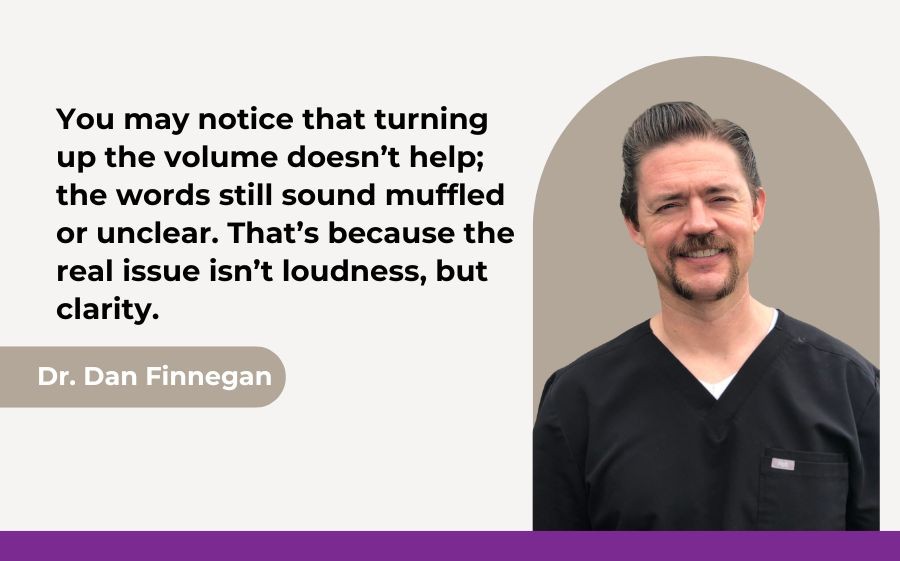
Additionally, this isn’t a loudness issue. Making things louder rarely, if ever, will solve this problem. This is a clarity issue due to the loss of filtering.
Listening Effort and Everyday Fatigue
Reduced spectral resolution and filtering are not the only side effects to a damage auditory system. Once the damage takes hold, your ears start to send incomplete and distorted information to your brain. Your brain must now work overtime to “fill in the gaps,” using context, facial cues and guesswork to piece together what’s being said. This extra effort can be mentally exhausting, especially in environments with lots of competing sounds. Listening fatigue from untreated hearing loss is real and is an often-overlooked consequence of a damaged auditory system.
Over time, this constant concentration can sap your energy and focus, making it harder to enjoy the activities and relationships that matter most to you. Many people don’t notice how much effort they’re putting in until it becomes overwhelming.
The Bigger Picture: Brain Health and Long-Term Effects
The strain of constantly working to understand speech in noise can have long-term consequences for your brain health. When your brain is forced to devote extra resources to listening, other cognitive functions, like memory and concentration, can suffer.
Recent research, including a 2023 study from Johns Hopkins University, has shown a strong link between untreated hearing loss and cognitive decline in older adults.
In addition to causing a large increase in listening effort/listening fatigue, prolonged under-stimulation of the brain from auditory damage can lead to missing conversational details, misunderstanding parts of the joke at the dinner table, and even accelerate age-related cognitive decline.
Social withdrawal can even further contribute to these risks. Again, early identification and intervention can reduce the long-term negative impacts on your brain, helping you maintain your cognitive health, quality of life and independence as you age.
Get Clear Answers About Your Hearing
You deserve to enjoy conversations without constant effort or frustration. Scheduling a full auditory system analysis is the best way to get clear answers about your hearing health.
You can rest assured that at Visalia Hearing Center, you benefit from our commitment to thorough diagnostics and honest guidance. Our focus is on helping you understand your auditory system, so you can make the most informed decisions possible.
Even if you’re not a candidate for hearing optimization, a thorough assessment can give you peace of mind and can help you plan for the future. Our expert team will guide you through every step of your hearing care journey.
To get started with our team, get in touch with us today. By taking a proactive step forward for your hearing health, you set yourself up for easier conversations, better daily energy, a more robust quality of life and long-term brain health!
Frequently Asked Questions (FAQ)
Q: Why do I struggle more in noisy places even if I hear well in quiet settings?
A: This is because early hearing loss doesn’t just reduce the volume; it often affects your ability to separate speech from noise. This means your brain has to work harder to fill in missing sounds, which is especially challenging when there’s a lot of competing noise.
Q: Can listening fatigue really affect my energy and mood?
A: Absolutely. When your brain is constantly straining to decode unclear speech, it uses up a lot of mental resources, leading to fatigue, reduced focus, and even changes in mood. Often times, when people have depleted their energy reserves, they just check-out of the conversation and stop participating altogether. Over time, this can absolutely impact your social life, work performance, and overall well-being.
Q: Is it true that untreated hearing loss can affect my brain health?
A: Yes. Studies, including a major 2023 study from Johns Hopkins, have linked untreated hearing loss with an increased risk of cognitive decline. Addressing hearing issues early helps reduce mental strain and supports long-term brain health.
As the adage goes, “If you don’t use it, you lose it.”
Source
Johns Hopkins University: This major 2023 study links untreated hearing challenges to an increased risk of cognitive decline.