Auditory System Analysis
Visalia Hearing Center Conducts a Complete Auditory System Analysis
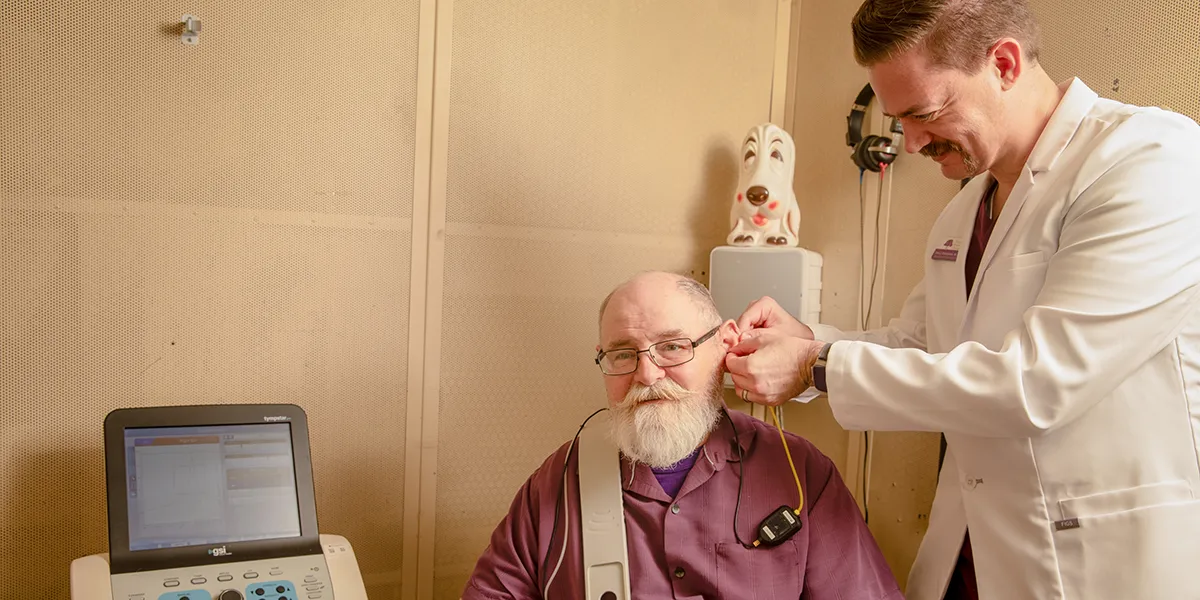
Plenty of hearing aid retail sales stores will entice you with offers of free hearing tests as a tool for getting their hearing aids into your ears. At Visalia Hearing Center, our primary goal is to get a thorough and accurate picture of the health of your auditory system. With the information we gather, we are better able to determine what treatment options, which may or may not include hearing aids, will adequately address your unique hearing challenges. Behavioral audiometry, impedance audiometry, otoacoustic emissions (OAE), and the Cognivue are just some of the services our audiologists use to understand what’s going on with your auditory system and how to respond with targeted solutions to overcome your hearing challenges.
Auditory System Analysis
Visalia Hearing Center Conducts a Complete Auditory System Analysis
Plenty of hearing aid retail sales stores will entice you with offers of free hearing tests as a tool for getting their hearing aids into your ears. At Visalia Hearing Center, our primary goal is to get a thorough and accurate picture of the health of your auditory system. With the information we gather, we are better able to determine what treatment options, which may or may not include hearing aids, will adequately address your unique hearing challenges. Behavioral audiometry, impedance audiometry, otoacoustic emissions (OAE), and the Cognivue are just some of the services our audiologists use to understand what’s going on with your auditory system and how to respond with targeted solutions to overcome your hearing challenges.
Auditory System Analysis
Visalia Hearing Center Conducts a Complete Auditory System Analysis
Plenty of hearing aid retail sales stores will entice you with offers of free hearing tests as a tool for getting their hearing aids into your ears. At Visalia Hearing Center, our primary goal is to get a thorough and accurate picture of the health of your auditory system. With the information we gather, we are better able to determine what treatment options, which may or may not include hearing aids, will adequately address your unique hearing challenges. Behavioral audiometry, impedance audiometry, otoacoustic emissions (OAE), and the Cognivue are just some of the services our audiologists use to understand what’s going on with your auditory system and how to respond with targeted solutions to overcome your hearing challenges.
Why Frequent Hearing
Assessments Are Necessary
According to the World Health Organization, about 466 million people worldwide struggle with disabling hearing loss, and they estimate that by 2050 that number could exceed 900 million.
Though these are alarming statistics, most people continue to schedule regular eye exams, dental checkups, and annual physicals and closely monitor their cholesterol and blood pressure, but hearing tests are far down the list of health screening priorities, if included at all.
Additionally, many who begin to experience the early signs of hearing loss put off getting the help they need for between seven and 10 years. While they wait, their hearing loss deteriorates even further and they begin to develop additional negative mental, physical, and psychological health conditions, affecting relationships, productivity, and their quality of life.
Frequent hearing assessments help monitor your hearing health, allowing you to take a proactive approach to hearing care rather than reacting to the damage to your capacity to communicate when it begins to interrupt your normal day-to-day routines.
What to Expect During an Auditory System Analysis
What to Expect During an Auditory System Analysis
Initial Interview
We start our consultations with a conversation about you. This conversation gives us the opportunity to get to know you better and helps us understand the challenges you’re facing and the goals you have for our time together.
We will ask questions about your occupation and lifestyle, including hobbies, special interests, and the types of leisure activities that you enjoy, as well as your medical history, any medications you’re taking, and any family history related to hearing loss.
The information we’ll gather will help us understand your risks of hearing loss. We believe in patient-centered care, so we’ll give you an opportunity to ask questions or express concerns related to your hearing loss and/or the hearing care services we provide.
Tinnitus is often among the symptoms of those experiencing hearing challenges due to a damaged auditory system, so be sure to bring it up during your initial interview if it’s an issue for you.
Initial Interview
We start our consultations with a conversation about you. This conversation gives us the opportunity to get to know you better and helps us understand the challenges you’re facing and the goals you have for our time together.
We will ask questions about your occupation and lifestyle, including hobbies, special interests, and the types of leisure activities that you enjoy, as well as your medical history, any medications you’re taking, and any family history related to hearing loss.
The information we’ll gather will help us understand your risks of hearing loss. We believe in patient-centered care, so we’ll give you an opportunity to ask questions or express concerns related to your hearing loss and/or the hearing care services we provide.
Tinnitus is often among the symptoms of those experiencing hearing challenges due to a damaged auditory system, so be sure to bring it up during your initial interview if it’s an issue for you.
Physical Examination of Your Ears
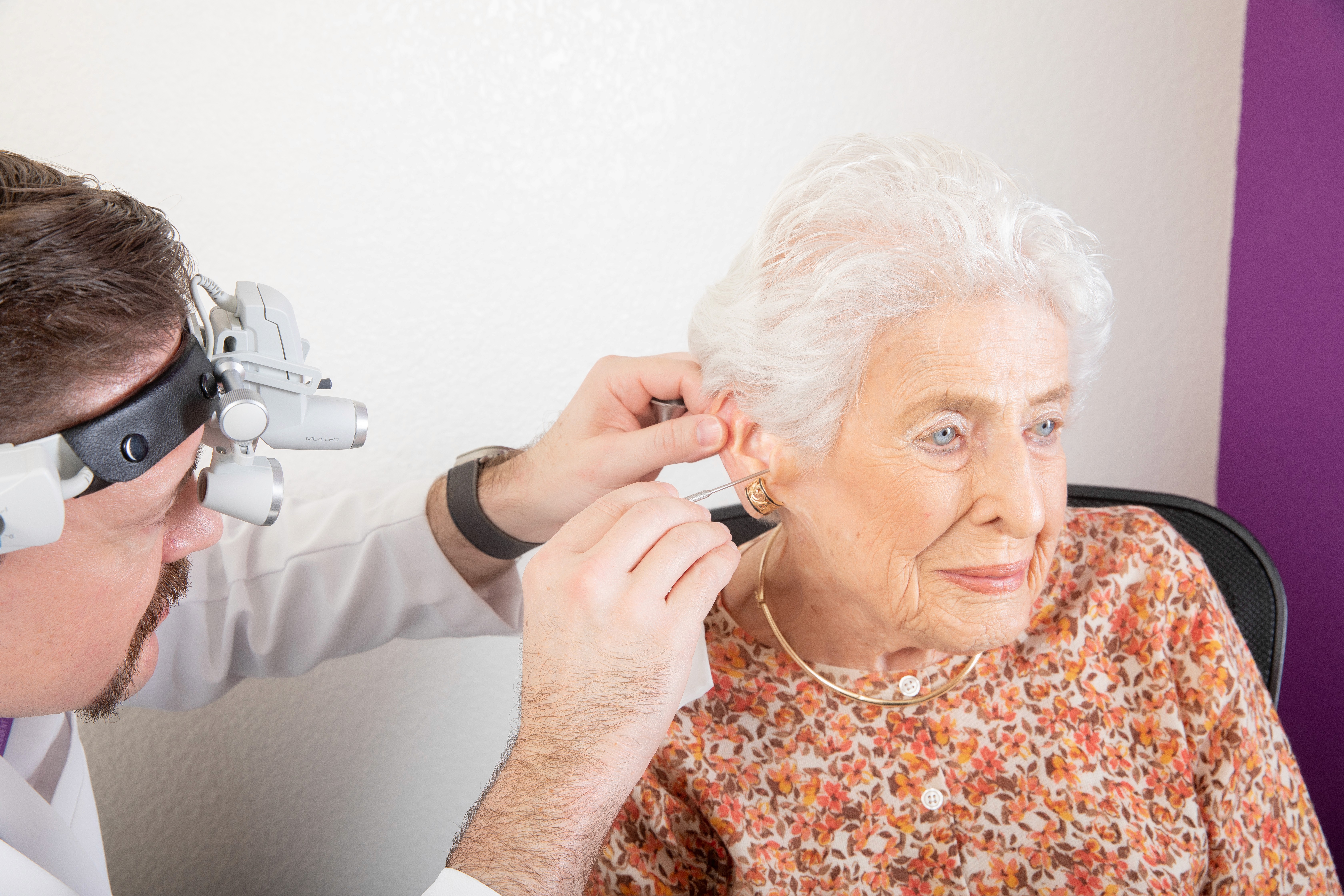
The next phase of a hearing test at Visalia Hearing Center is a physical examination of your ears using an otoscope, which is a magnifying glass with a light in a tapered tip. The purpose of a physical examination of your ears is to evaluate the health of the ear canal and eardrum. We’ll look for skin conditions, earwax accumulation, or the presence of other obstructions in your ear canal.
In some cases, restoring your hearing requires little more than removing earwax, a bug, or some other foreign object, and in other cases, we might find inflammation or a growth that is blocking your ear canal.
Physical Examination of Your Ears
The next phase of a hearing test at Visalia Hearing Center is a physical examination of your ears using an otoscope, which is a magnifying glass with a light in a tapered tip. The purpose of a physical examination of your ears is to evaluate the health of the ear canal and eardrum. We’ll look for skin conditions, earwax accumulation, or the presence of other obstructions in your ear canal.
In some cases, restoring your hearing requires little more than removing earwax, a bug, or some other foreign object, and in other cases, we might find inflammation or a growth that is blocking your ear canal.
Hearing Tests
During the next phase of your hearing evaluation, we will conduct a series of audiometric tests designed to determine the type and severity of your hearing loss.
Sound Booth Examinations
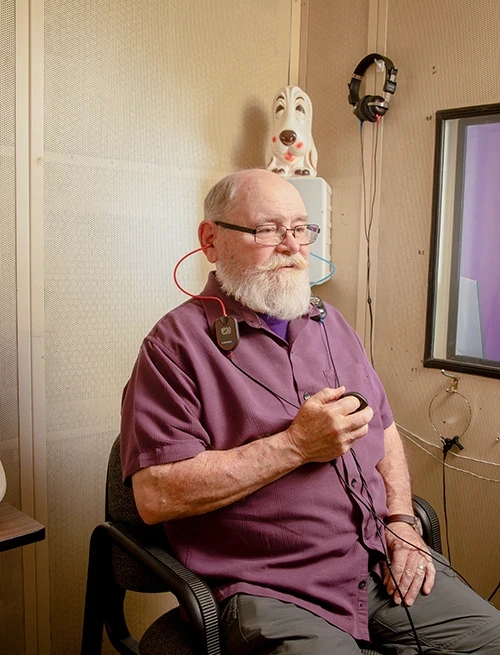
This is the real “meaty” part of the appointment. An entire 40+ minute battery of tests will be used to ensure the correct type and severity of hearing loss is diagnosed and proper treatment options are recommended. To get the desired outcome, these measurements should not be completed on a smartphone/tablet with wireless headphones or at a table in an open room – they must be done with calibrated diagnostic equipment in a certified sound treated booth.
Pure Tone Threshold Tests (Audiometry)
Both bone conduction and air conduction threshold testing are used to measure the level of hearing. The two tests are similar in that they each use pure tones but differ in the means of testing. Air conduction testing sends the tone to the ear through inserted earphones, while bone conduction testing uses a bone oscillator that delivers the sound through the mastoid bone, which is the bone right behind the ear, directly to the inner ear. By skipping the outer and middle ears, bone conduction testing can help narrow down the location of the hearing loss. This test is commonly known as the “beeping” test.
Word Recognition/Discrimination Tests
Since humans don’t spend most of their time listening to beeping sounds, understanding how well your auditory system processes speech is important. This is where word recognition testing is crucial – it gives us the information that is most meaningful to the patient and audiologist.
Ideally, this testing is done in the patient’s native language and uses the gold standard of recorded speech stimuli. Each ear will be assessed individually at different volumes as well as both ears together to measure the binaural advantage and rule out binaural interference. Word recognition/discrimination measurements are a key indicator of how well an individual will respond to treatment.
Impedance/Immittance Audiometry
Objective, physiologic measurements obtained from impedance/immittance equipment, like the TympStar Pro at Visalia Hearing Center, assist audiologists in analyzing the middle ear system and really narrowing down the location of your hearing loss. Tympanometry, or “the eardrum test,” acoustic reflexes, and acoustic reflex decay are the most common measurements in this section. Tympanometry is especially helpful in detecting the presence of fluid in the middle ear, in which case your hearing loss is likely temporary and easily treated by a medical doctor.
Speech-in-Noise Testing
Speech-in-noise testing, such as the QuickSIN, BKB SIN, or ACT, evaluates how well you process sound and understand speech in noisy, real-world settings. Since people with a hearing loss most often report difficulty discerning speech in a noisy environment, this assessment can help your audiologist choose the right hearing aid to best suit your hearing needs.
Additional tests, such as the TEN test, AZ-Bio, Weber/Rinne, Stenger, and/or OAEs, to name a few, may be necessary in some cases, but the measurements discussed above are the tests that are most commonly performed.
Hearing Tests
During the next phase of your hearing evaluation, we will conduct a series of audiometric tests designed to determine the type and severity of your hearing loss.
Sound Booth Examinations
This is the real “meaty” part of the appointment. An entire 40+ minute battery of tests will be used to ensure the correct type and severity of hearing loss is diagnosed and proper treatment options are recommended. To get the desired outcome, these measurements should not be completed on a smartphone/tablet with wireless headphones or at a table in an open room – they must be done with calibrated diagnostic equipment in a certified sound treated booth.
Pure Tone Threshold Tests (Audiometry)
Both bone conduction and air conduction threshold testing are used to measure the level of hearing. The two tests are similar in that they each use pure tones but differ in the means of testing. Air conduction testing sends the tone to the ear through inserted earphones, while bone conduction testing uses a bone oscillator that delivers the sound through the mastoid bone, which is the bone right behind the ear, directly to the inner ear. By skipping the outer and middle ears, bone conduction testing can help narrow down the location of the hearing loss. This test is commonly known as the “beeping” test.
Word Recognition/Discrimination Tests
Since humans don’t spend most of their time listening to beeping sounds, understanding how well your auditory system processes speech is important. This is where word recognition testing is crucial – it gives us the information that is most meaningful to the patient and audiologist.
Ideally, this testing is done in the patient’s native language and uses the gold standard of recorded speech stimuli. Each ear will be assessed individually at different volumes as well as both ears together to measure the binaural advantage and rule out binaural interference. Word recognition/discrimination measurements are a key indicator of how well an individual will respond to treatment.
Impedance/Immittance Audiometry
Objective, physiologic measurements obtained from impedance/immittance equipment, like the TympStar Pro at Visalia Hearing Center, assist audiologists in analyzing the middle ear system and really narrowing down the location of your hearing loss. Tympanometry, or “the eardrum test,” acoustic reflexes, and acoustic reflex decay are the most common measurements in this section. Tympanometry is especially helpful in detecting the presence of fluid in the middle ear, in which case your hearing loss is likely temporary and easily treated by a medical doctor.
Speech-in-Noise Testing
Speech-in-noise testing, such as the QuickSIN, BKB SIN, or ACT, evaluates how well you process sound and understand speech in noisy, real-world settings. Since people with a hearing loss most often report difficulty discerning speech in a noisy environment, this assessment can help your audiologist choose the right hearing aid to best suit your hearing needs.
Additional tests, such as the TEN test, AZ-Bio, Weber/Rinne, Stenger, and/or OAEs, to name a few, may be necessary in some cases, but the measurements discussed above are the tests that are most commonly performed.
A Discussion About Your Test Results
Once we’ve finished testing, we’ll show you the test results and explain them to you. If testing shows that you are experiencing hearing loss, your audiologist will explain the various treatment solutions available to address your unique type and severity of hearing challenges.
Should you test normal, your audiologist will discuss ways to protect or improve your hearing using hearing protection for work or certain activities and hobbies, as well as changes to your medications or lifestyle habits.
We value your input during this process, because to us, the foundation upon which to build a viable hearing care partnership begins with transparency and trust.
A Discussion About Your Test Results
Once we’ve finished testing, we’ll show you the test results and explain them to you. If testing shows that you are experiencing hearing loss, your audiologist will explain the various treatment solutions available to address your unique type and severity of hearing challenges.
Should you test normal, your audiologist will discuss ways to protect or improve your hearing using hearing protection for work or certain activities and hobbies, as well as changes to your medications or lifestyle habits.
We value your input during this process, because to us, the foundation upon which to build a viable hearing care partnership begins with transparency and trust.
Schedule an Auditory System Analysis Appointment
If you’re struggling to hear conversation in a crowded restaurant, if others complain that the volume of your television is too loud, or if friends and family continuously harass you about getting “your ears checked,” your first step to knowing the truth about your hearing is an auditory system analysis.
At Visalia Hearing Center, we go beyond your typical hearing test to get a complete picture of your hearing health. Contact us for an auditory systems analysis by submitting the adjacent form, and a member of our team will call you to assist with scheduling.
Schedule an Auditory System Analysis Appointment
If you’re struggling to hear conversation in a crowded restaurant, if others complain that the volume of your television is too loud, or if friends and family continuously harass you about getting “your ears checked,” your first step to knowing the truth about your hearing is an auditory system analysis.
At Visalia Hearing Center, we go beyond your typical hearing test to get a complete picture of your hearing health. Contact us for an auditory systems analysis by submitting the adjacent form, and a member of our team will call you to assist with scheduling.
Schedule an Auditory System Analysis Appointment
If you’re struggling to hear conversation in a crowded restaurant, if others complain that the volume of your television is too loud, or if friends and family continuously harass you about getting “your ears checked,” your first step to knowing the truth about your hearing is an auditory system analysis.
At Visalia Hearing Center, we go beyond your typical hearing test to get a complete picture of your hearing health. Contact us for an auditory systems analysis by submitting the adjacent form, and a member of our team will call you to assist with scheduling.
Who should do my hearing assessment?
The answer depends on what your goals are:
A) buying a hearing aid or B) fully understanding the intricacies of your auditory system.
If your goal is simply to buy a hearing aid, hearing aid salespeople are a great choice because their primary motivation and what they're licensed to do is exactly what you're looking for. Hearing aid salespeople perform basic hearing tests/screenings, similar to what you can get on your smart phone, they're generally free, you're in and out of the booth in under 10 minutes and then you're onto being sold.
If your goal is to get a full diagnostic work up, rule out medical conditions, and/or get a firm understanding about your own auditory capacity, you need to see a Doctor or Audiology. Doctors of Audiology are more interested in your overall hearing health, how your hearing loss is affecting you and your family's day-to-day lives, and providing patient-centered care; therefore, assessments with Audiologists are far more comprehensive and accurate. In fact, testing the follows Audiologic Best Practice can last over 45 minutes. More importantly, if hearing aids are needed, the extensive information gleaned from this diagnostic approach to hearing assessment leads to more favorable outcomes with hearing aids.
How often should I have my hearing tested?
Do I need someone to come with me for my hearing test?
When will I know the results from my hearing test?
What kind of test results can I expect to see?
What do I do with my test results?
How do I prepare for a hearing test?
I already wear aids. Can I still come in for a hearing test?
Your Questions Answered
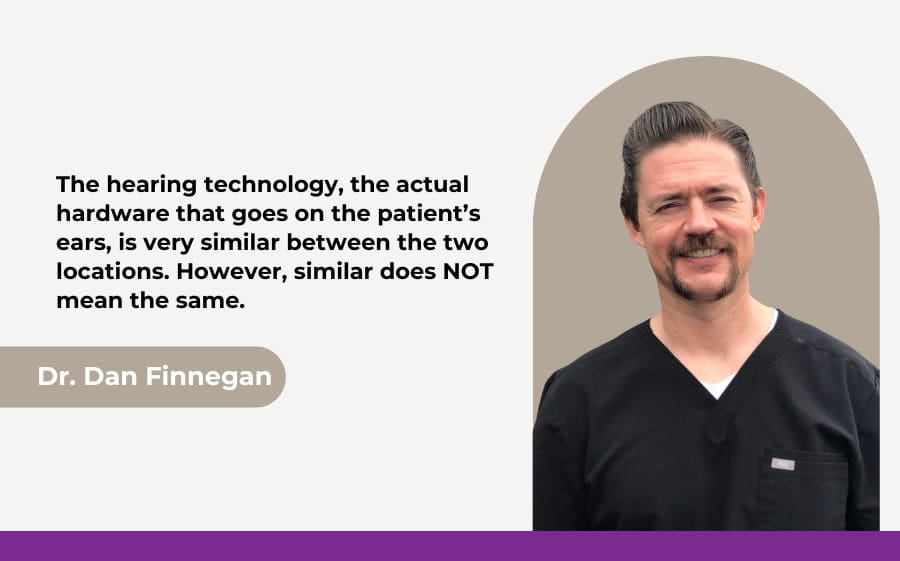
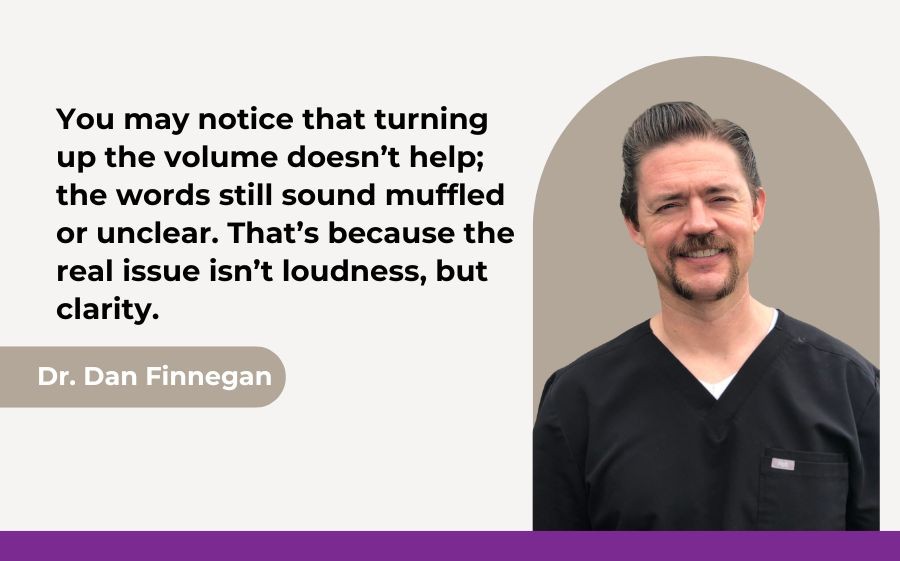
Hearing Health is Brain Health: Why You Can Hear, But Not Understand

|
Dr. Dan Finnegan
|
Mar 19, 2026
If you find yourself telling your loved ones, “I can hear you — I just can’t understand you,” you’re not alone.
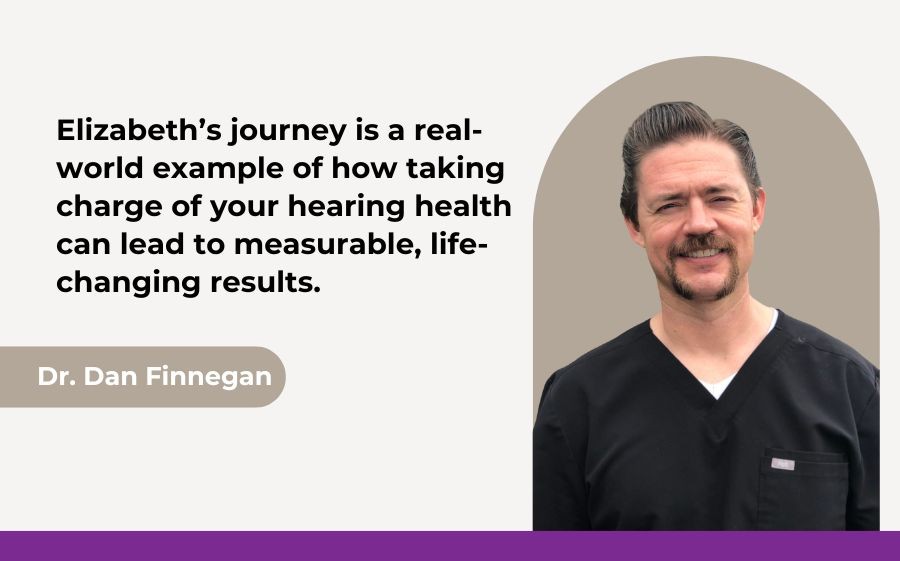
Elizabeth’s Hearing Health Journey: How Better Hearing Care Changed Everything
|
Dr. Dan Finnegan
|
Feb 10, 2026
Untreated hearing loss can impact more than just your ability to follow conversations.
Your Questions Answered
Hearing Health is Brain Health: Why You Can Hear, But Not Understand
|
Dr. Dan Finnegan
|
Mar 19, 2026
If you find yourself telling your loved ones, “I can hear you — I just can’t understand you,” you’re not alone.
Elizabeth’s Hearing Health Journey: How Better Hearing Care Changed Everything
|
Dr. Dan Finnegan
|
Feb 10, 2026
Untreated hearing loss can impact more than just your ability to follow conversations.
Your Questions Answered
Setting Benchmarks of Audiological Excellence
Contact us
Mon-Thurs: 8:30am – 5pm
Fri: 8am – Noon
Setting Benchmarks of Audiological Excellence
Contact us
Mon-Thurs: 8:30am – 5pm
Fri: 8am – Noon
Setting Benchmarks of Audiological Excellence
Contact us
Mon-Thurs: 8:30am – 5pm
Fri: 8am – Noon