Treatment Plans
Invest in What Matters: Hearing Health That Works for You
There is a lot of confusion surrounding the cost of hearing care and hearing aids; if you’ve done any internet research, you’ll find the prices to optimize hearing in both ears can range from $300 to over $9,000. That’s an incredible range!
The most important thing to consider when making a purchasing decision is what exactly you are getting for the price you’re paying. That’s how we define the real meaning of value. Cheap price or low cost by themselves do not equate to good value, especially when the cheap price doesn’t solve the hearing challenges you’re faced with.
I would Like to Share a Story With You
We hear a version of this story once or twice per year, every year. It’s the patient who had an appointment with us but didn’t move forward. In the course of our due diligence, we reach out to the person to see how we can be of further assistance.
At this time, we hear a level of exuberance that they purchased hearing aids somewhere else. They tell us about the deal they got because they saved $2000 to $4000 getting hearing aids over there instead of with us.
When we ask how they are doing with their hearing aids, they dodge that question and proudly respond again how much they saved by going elsewhere instead.
It’s interesting that these patients never talk about what they spent, they only talk about what they saved. And when you dive deeper and you discover they’re not actually wearing the hearing aids! Yet somehow, they’re still delighted with their deal?
This situation is not a deal: it’s the definition of a rip-off. Of course, a year or two later, these patients return saying they need to do something different this time. They reach the conclusion that if we can get reasonably close to solving their hearing challenges, it will be worth every penny. When we do our job, these patients then become our most loyal advocates and brand ambassadors.
You can avoid the above situation entirely by educating yourself on what you need to do to enhance your hearing. Yes, when hearing care is done the right way, it won’t be without an investment.
As of Spring 2025, prices at Visalia Hearing Center will range from roughly $2000–$7600.*

Hearing Care & Optimization Overview
At Visalia Hearing Center, we are known for and take pride in, our comprehensive hearing care and optimization packages. That's because a hearing aid alone will not solve your hearing challenges.
To achieve the highest quality outcomes, we only incorporate prescriptive hearing aids into our hearing care packages. We are not anti-OTC devices, we are just very pro-prescriptive hearing aids (if you want more on our thoughts about OTC devices, please click here).
When looking at what factors cause the investment amount of our care packages to increase or decrease, two things come to mind:
A) Computer chip technology/tier: Think of this as the brains of your hearing aid. The smarter the brain, the better you hear, the more you pay.
B) Service/warranty/care package: Think of this as how much of Visalia Hearing Center's time/professional services are included. More services included & a longer warranty period means you pay more than a package with less services and warranty included.
We offer 4 different computer chip technologies: premium, advanced, smart, and essential, as well as two different service models, bundled or unbundled. As a reference, premium technology with bundled care will be at the highest end of our price range ($7,540) while essential technology with an unbundled care package will be the lowest end of our price range ($1,970).
Our two most popular technology tiers are Premium and Smart. Most choose a bundled care model (we call it our Continued Care and Coverage Plan or CCCP for short) over an unbundled care. The small behind-the-ear, receiver-in-canal (RIC) style devices comprise > 80% of our fittings, and most (> 90%) are choosing rechargeable devices or a disposable battery model.
While we have happy patients in all 6 of the major hearing aid brands (in alphabetical order, Oticon, Phonak, ReSound, Starkey, Signia & Widex), since 2024 our three most popular brands are Oticon, Phonak & ReSound.
Now for those who love to get into the weeds, we will now dive into more details and breakdown the differences in Hearing Aid Computer Chip Technologies available at Visalia Hearing Center:
Every Hearing Aid Manufacturer has a portfolio of options to choose from. Some of our manufacturing partners have 4 tiers (Oticon, Phonak & Widex), one has 5 tiers (Starkey) and two even have 6 tiers (ReSound & Signia). To ease the decision-making process, we've consolidated the technology tiers down to 4 options: Premium (The Best), Advanced (The Better), Smart (The Good), & Essential (The OK).
Every company's Top-of-the Line is in the premium category, one step down is Advanced and two steps down is Smart. The Essential tier is a bit jumbled but it's essentially comprised of each manufacturer's lowest priced option that still has iPhone connectivity and a rechargeable option. We have included a little description of each if you hover over each of the boxes below.
Premium (The Best)
Advanced (The Better)
Smart (The Good)
Essential (The OK)
Looking for More Details?
For those who are curious about the technical differences between premium, advanced, smart & essential, we have included the most recent Portfolios from each of the 6 major hearing aid manufacturers for your review below by clicking:
Without going too far into the weeds, anyone can look at the portfolio of options and discover that Premium hearing aids have the most features, and each time you drop down a technology tier, you lose more and more features. Each tier offers very different hearing aids.
The basic crux of these features is to improve listening comfort and performance in noise. All hearing aid technology tiers will help you hear better in quiet; not all tiers are designed with managing background noise in mind.
Like most options in Capitalism, the hearing aid market is the epitome of the pay more, get more, pay less, get less mantra.
As of May 2025, here are our 6 manufacturing partners technology breakdown (in alphabetical order):
Intent 1 (Premium)
Intent 2 (Advanced)
Intent 3 (Smart)
Intent 4 (Essential)
Infinio Sphere 90 (Premium)
Infinio Sphere 70 (Advanced)
Infinio 50 (Smart)
Infinio 30 (Essential)
Vivia 9 (Premium)
Vivia 7 (Advanced)
Vivia 5 (Smart)
Savi 3 (Essential)
IX 7 (Premium)
IX 5 (Advanced)
IX 3 (Smart)
IX 1 (Essential)
Omega AI 24 (Premium)
Omega AI 20 (Advanced)
Omega AI 16 (Smart)
Genesis AI 12 (Essential)
Allure 440 (Premium)
Allure 330 (Advanced)
Allure 220 (Smart)
Moment 110 (Essential)
For those who do want to go into the weeds, you can even compare across brands and see that every company is offering pretty much the same thing. All companies incorporate some form of Artificial Intellegence (AI)/Deep Nueral Network (DNN), all connect directly to an iPhone, and all offer rechargeable models. All companies offer more than enough channels to adequately frequency shape, all have directional microphones, phase inverting feedback managers, and frequency lowering options, etc. Our opinion is that technological differences don't really set the brands apart.
We believe they're all equally great and we believe any manufacturer's premium/advanced/smart/essential offering is comparable to any other company's offering at the same tier. Similarly, any manufacturer's premium hearing aid is better than any other manufacturer's Advanced hearing aid and any company's Smart offering is better than any other company's Essential offering. And YES, if there really was one manufacturer that was THAT MUCH better than everyone else, we'd be screaming that from our rooftops. But that's just not the case.
Bundled vs. Unbundled
The 2nd factor that drives the cost of your hearing care and optimization package is the scope and duration of included professional services/labor/warranty. Think of this as how much of your Doctor's time is included with your initial purchase.
Visalia Hearing Center offers two different care models:
Bundled vs. Unbundled.
If you're curious which care model is best for you, please continue reading!
Bundled
Pay more up front and in return, there is little to no cost for office visits and professional services for the next 2, 3 or 4 years. Think of a health insurance plan with a higher premium but a very small deductible.
This model is great for patients new to the hearing care world, those who need a lot of hand holding, and for those who just like to be taken care of. If you're looking for a patient-centered, relationship-based care model that adheres to Audiology Best Practices, this is the plan for you.
If you're looking for a proactive and long-term vision for your care while not being "nickel and dimed" every time you're seen, you want a bundled care plan.
If you believe that the pay-more-get-more mantra leads to better value, then a bundled care plan speaks to you.
A bundled care plan gives patients price certainty and exposes them to almost no price-related friction points.
While it is true that the bundled care model has a guaranteed, higher up front cost, if you were to follow the prescribed preventative maintenance schedule and receive all recommended services over a comparable 2, 3 or 4 year period, you wind up saving a ton of money relative to the unbundled care model. We feel the bundled care approach is the best value we offer, and it's the plan we recommend for the vast majority of patients.
Unbundled
The upfront cost drops compared to a bundled care plan, you get 90 days of limited office visits/services, then on day 91, you transition to the pay as you go model anytime you need our professional help.
Think of the high-deductible health care plans: the lowest premiums you've ever paid but the highest co-pays/share of cost when you are seen. This plan really speaks to those individuals who love to self-insure, to those who only want to pay for only what they absolutely need and/or to those who would rather do it themselves than pay somebody else to do it for them.
If you believe that the pay-less-get-less mantra leads to better value, then an unbundled care plan speaks to you. Patients who choose this plan tend to be younger (lesser degree of hearing loss, better dexterity, better vision, less cognitive issues, etc.), very tech savvy (understand smart phones, Apps & how to pair Bluetooth), and can easily figure things out of their own.
While the unbundled care plan gives a large upfront price savings, it also introduces a fair amount of price uncertainty and exposes patients to the potential of price-related friction points.
While there is absolutely a chance for you to save money over the long-term with an unbundled care plan, there's also just as much of a chance for you to spend more money than you would have if you had chosen a bundled plan, too. Because most hearing aid users are from the mature demographic, prefer price certainty over price uncertainty, and want to avoid friction points, the unbundled plan is not recommended often.
In a nutshell, you need to pay for your Doctor's time one way or the other. You can either pay for it upfront and not have to worry about it for several years, or you have to pay as you go every time you're seen. As the patient, you get to decide!
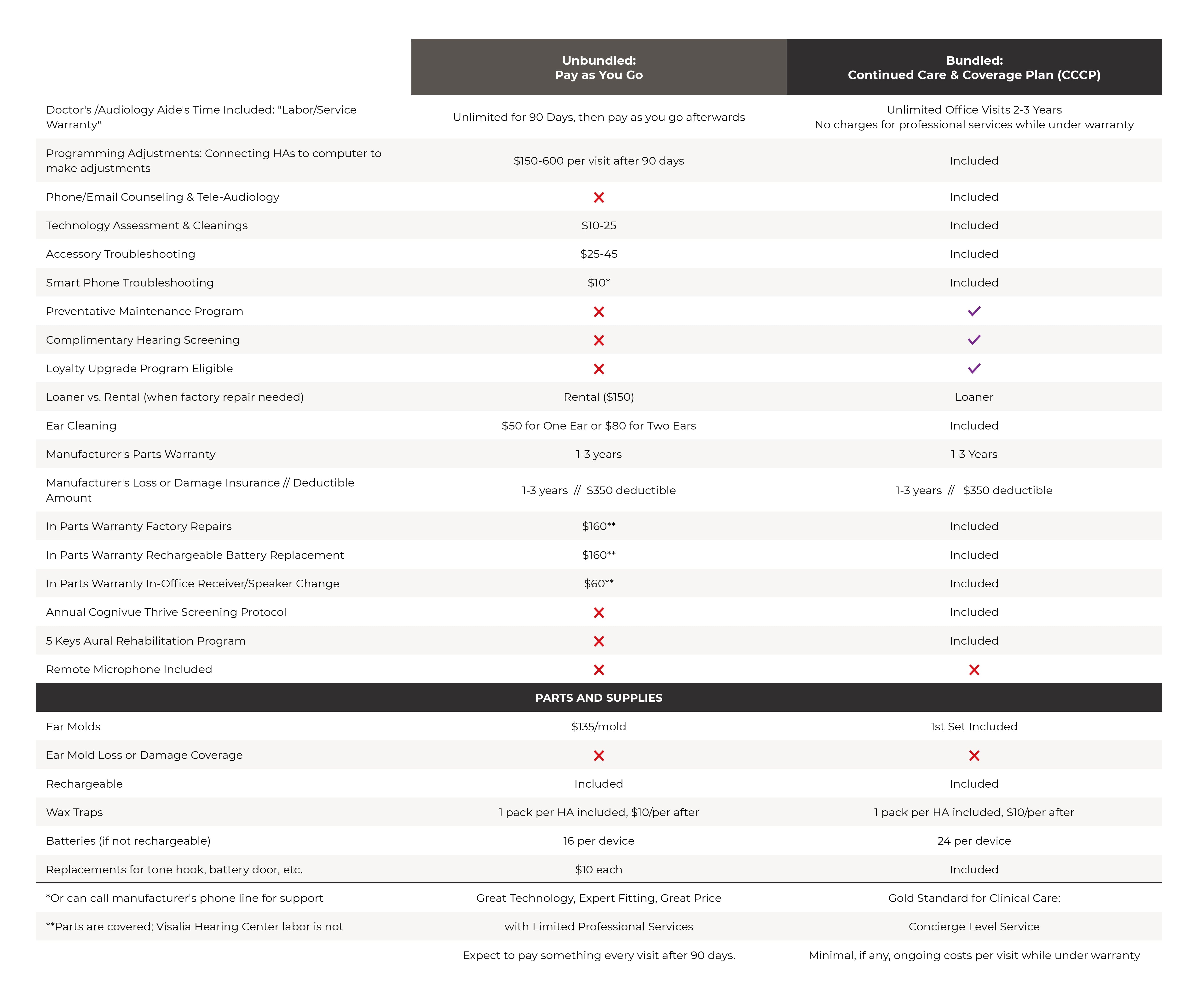
This chart compares what services and benefits are included with our Continued Care & Coverage Plan versus pay-as-you-go care.
What Factors Do NOT Drive the Cost of Your Hearing Care Package:

#2. Brand of hearing aid
#3. The style of hearing aid
#4. Your lifestyle
Your Care Plan
Every patient’s hearing needs are different. Use the calculator below to customize your treatment level and care plan to see an estimated investment in better hearing.
How to Shop for Hearing Care, Not Just Devices
The technology matters - but the expertise behind it matters more. The right provider will guide you through a comprehensive evaluation, help you choose appropriate technology, and program it precisely for your hearing needs. Long-term success depends far more on the quality of care than the brand of device. Here’s what to look for when choosing hearing care the right way
Shop for hearing care, not hearing aids. That’s because the solution to hearing challenges is quality hearing care, not simply purchasing hearing aids.
The person you choose to work with plays a larger role in your hearing success than the hearing aid. Choose wisely. Properly vet them. What are their credentials? Board Certifications? Your efforts should be focused on finding the right person/team, and they will lead you to the right hearing care plan.
If you have symmetric hearing, the recommendation must be to help both ears (if you decide to only aid one ear, that’s your prerogative). If you’re a candidate for two hearing aids and your provider states you’ll do fine with one hearing aid, that provider doesn’t know what they’re doing, and you should immediately find someone else to work with.
Premium technology is absolutely the best hearing technology available. It is also the most expensive. There is nothing wrong with lower-tired hearing aids; they can work very well, but they do not address hearing challenges like Premium offerings do. If you can afford premium hearing aids, that’s what you should get.
Make sure you're getting flagship-branded hearing aids from one of the big 6 manufacturers (Oticon, Phonak, ReSound, Signia, Starkey, Widex). Again, there's nothing wrong with generics, but branded models often offer better support and reliability. Again, there’s nothing wrong with generic or sister company branded devices, but they’re not the same*.
Additionally, if you get a private label or sister company branded devices, there’s a very high probability that only the location/organization that sells you that device can program it (for better or worse you’re stuck there until you get new hearing aids).
*For more information on flagship vs. sister company branded hearing aids, please click here.
Centers who work with multiple name brand hearing aids are generally far more qualified than centers that only work with one brand. The sweet spot to look for is a center that routinely and confidently can fit 3 (or more) brands.
Tips for choosing Hearing Aid Brand
Existing Hearing Aid Users who are Upgrading:
If you've been successful/heard reasonably well with your current hearing aids, stick with same brand with your next upgrade. Your auditory system is already locked into the cues that technology is giving you and the smoothest transition to new devices will be the same brand. There's no need to reinvent the wheel. If your Audiologist wants to change brands, I sure hope they're presenting a very compelling reason.
If you've been unsuccessful/heard like "meh" with your current hearing aids, you need to upgrade to anything else but the brand you've been using. If we don't learn from history, we're doomed to make the same mistakes.
New Hearing Aid Users:
Do your own reseach prior to visiting with an Audiologist. If you find a technology or brand that really speaks to you, let your Audiologist know and they'll make it happen for you. There are rare instances where an individual's auditory system is a bad fit for a certain brand, but for the most part, if your Audiologist has talent, they should be able to make any brand of hearing aid help you reach your full auditory potential, whatever your full auditory potentil is.
If you're like most people and just wants the lights to come on without thinking too much about it, find an Audiologist you can trust and let them choose for you. Again, the secret sauces is not the hearing aid or brand of the device, but the person programming and the team supporting those devices.
The bare minimum time needed for an effective initial assessment and consultation for hearing care is 90 minutes. If your hearing care provider is following Audiologic Best Practices, there’s no way around this. If your initial consultation to discuss hearing aid options is 60 minutes or less, corners are being cut and will undoubtedly cause a compromise to the quality of your care.
From an initial consultation and assessment standpoint, you often get what you pay for. Clinics that perform “free” hearing tests are more focused on selling hearing aids than providing exceptional hearing care.